Digital Fax Security: Common Questions Answered
How online fax services secure PHI with TLS 1.2+, 256-bit AES, BAAs, audit logs, and practical HIPAA-compliant faxing best practices.
Digital Fax Security: Common Questions Answered
Digital faxing is a safer, more secure alternative to traditional fax machines, especially for industries like healthcare, legal, and government. The risks of outdated fax methods - like interception, misdelivery, and lack of encryption - can lead to regulatory violations and data breaches. Modern online fax services address these issues with encryption, compliance tools, and secure storage.
Here’s what you need to know:
- HIPAA Compliance: Online faxing must meet strict standards for protecting Protected Health Information (PHI). This includes encryption, secure storage, and audit trails.
- Encryption: Services use protocols like TLS 1.2+ for transmission and 256-bit AES for storage to protect sensitive data.
- Business Associate Agreements (BAAs): Essential for compliance with regulations like HIPAA, BAAs outline responsibilities for handling sensitive information.
- Audit Logs: Track every fax transaction to ensure transparency and compliance.
- Cost Options: Pay-per-fax models (like OneFaxNow) are ideal for occasional use, while subscription plans (like Fax.Plus) suit frequent faxing needs.
Modern fax services not only protect sensitive data but also simplify compliance with regulations like HIPAA, GDPR, and CCPA. Choose a service that aligns with your needs - whether it’s real-time tracking, instant BAA execution, or flexible pricing.
What Is HIPAA-Compliant Faxing?
Given the security risks associated with handling sensitive information, understanding HIPAA-compliant faxing is crucial for protecting Protected Health Information (PHI). Whether you're running a small clinic, managing a hospital network, or working for a healthcare billing company, knowing the basics of HIPAA compliance can help shield your organization from legal and financial trouble.
HIPAA-Compliant Faxing Explained
HIPAA-compliant faxing involves using services designed to secure PHI through multiple layers of protection, such as advanced encryption (e.g., 256-bit AES for storage and TLS 1.2+ for transmission). PHI includes any information that identifies a patient and pertains to their health, treatment, or billing.
"Our products are designed with top-tier security and privacy at their core. We're dedicated to meeting key certifications and compliances like SOC 2, HIPAA, ISO 27001, GDPR, and CCPA, ensuring our solutions align with global standards." – Fax.Plus [1]
The goal is straightforward: ensure that every fax containing PHI is safeguarded against unauthorized access. This protection covers the entire lifecycle of the fax - from upload to transmission to storage - keeping sensitive patient data confidential at all times.
HIPAA Rules Relevant to Faxing
Two major HIPAA rules dictate how faxed communications should be managed: the Security Rule and the Breach Notification Rule.
- The Security Rule: This sets standards for protecting electronic PHI (ePHI). When a fax is sent using an online service, it becomes ePHI once it’s digitized. To comply, healthcare organizations must use fax services that provide encryption, secure storage, restricted access through user authentication, and detailed audit logs.
- The Breach Notification Rule: This mandates that any unauthorized access, use, or disclosure of PHI must be reported to affected individuals and relevant authorities. For instance, if a fax is sent to the wrong number or intercepted during transmission, it could constitute a breach. Using a compliant fax service and signing a Business Associate Agreement (BAA) with the provider can help mitigate these risks by ensuring PHI is handled in accordance with HIPAA standards.
Violations of these rules can have serious consequences, making compliance a top priority.
The Cost of Non-Compliance
Not using a HIPAA-compliant fax service can lead to steep financial penalties, legal challenges, and reputational harm. Beyond fines, organizations may face lawsuits and increased regulatory scrutiny. This is why it’s critical to partner with fax providers offering clear compliance measures.
For example, OneFaxNow offers a HIPAA mode that includes BAAs, which can be signed directly through their dashboard. This simplifies the process for healthcare organizations to maintain compliant faxing practices and avoid the risks associated with non-compliance.
How Encryption Protects Digital Fax Transmissions
Encryption plays a key role in securing fax data by converting it into an unreadable format that only authorized parties with the correct decryption key can access. Without encryption, fax data travels in plain text, making it vulnerable to interception by anyone with access to the transmission path. This lack of security is especially concerning for industries like healthcare, legal services, and government agencies that handle sensitive information. Let’s dive into how encryption ensures your fax data stays safe from sender to recipient.
Point-to-Point Encryption Explained
Point-to-point encryption safeguards fax data throughout its entire journey. It converts the information into an unreadable format, keeping it secure as it moves through servers, networks, and communication channels, until it reaches the intended recipient.
Digital fax services take this a step further by encrypting data both in transit and at rest. In-transit encryption protects your data as it moves from your device to the fax service's servers and then on to the recipient. Meanwhile, at-rest encryption ensures that stored documents remain secure, even if someone gains unauthorized access to the storage system. Without the decryption key, the data remains inaccessible.
"We use strong 256-bit AES encryption for stored documents, with each user having their own unique encryption key. We also ensure secure data transfer between our apps and servers (mobile, API, web) using TLS 1.2+ encryption." – Fax.Plus [1]
By assigning each user a unique encryption key, digital fax services add an extra layer of protection against unauthorized access.
Common Encryption Standards for Faxing
Modern digital fax services rely on two widely recognized encryption standards: TLS 1.2+ for data in transit and 256-bit AES for stored data.
- TLS 1.2+ (Transport Layer Security): This protocol secures the connection between your device and the service's servers. Whether you’re using a web browser, mobile app, or API integration to send a fax, TLS creates an encrypted tunnel that prevents eavesdropping during transmission. It’s the same technology that protects online banking and other sensitive transactions.
- 256-bit AES (Advanced Encryption Standard): This encryption standard protects documents stored on the provider’s servers. Its massive number of possible key combinations makes brute-force attacks practically impossible with current technology.
"Every fax you send and receive is safeguarded, ensuring your information remains protected and private." – Fax.Plus [1]
Fax.Plus employs both of these encryption standards, ensuring compliance with key regulations like HIPAA, SOC 2, ISO 27001, GDPR, and CCPA.
Security Risks of Unencrypted Faxing
The risks of unencrypted faxing are significant, highlighting the importance of strong encryption. Traditional fax machines and some basic online fax services often transmit documents in plain text, making them susceptible to interception. This leaves sensitive data - such as patient records or legal documents - exposed to potential breaches during transmission.
Interception is a major concern. When fax data travels unencrypted over phone lines or internet connections, it can be captured using easily available tools. Additionally, storing unencrypted faxes opens the door to risks like hacking, stolen credentials, or insider threats.
Another issue with unencrypted systems is the lack of proper audit trails, which makes it harder to detect and respond to breaches. In contrast, digital fax services that use TLS 1.2+ and 256-bit AES encryption ensure that data remains secure both during transmission and while stored.
Strong encryption isn't just about security - it’s also about compliance and trust. For example, OneFaxNow offers an optional HIPAA mode that employs these encryption standards, ensuring compliance when sending sensitive documents like medical records or government forms. By choosing a service with robust encryption, you can protect your data, meet regulatory requirements, and avoid the pitfalls of unencrypted faxing.
Required Security Features for HIPAA-Compliant Fax Services
When dealing with Protected Health Information (PHI), ensuring HIPAA compliance isn’t optional - it’s a must. If you're using a digital fax service to send medical records, insurance forms, or patient data, it needs to meet strict security standards. These safeguards are in place to protect patient privacy and prevent any violations.
Business Associate Agreements (BAAs)
A Business Associate Agreement (BAA) is a non-negotiable requirement under HIPAA whenever a third-party service handles, stores, or transmits PHI for a covered entity. If you're using an online fax service for PHI, having a signed BAA is essential.
This agreement spells out the fax service’s responsibilities, like implementing proper safeguards, reporting any data breaches, and restricting how PHI is used or disclosed. Even with strong encryption and other security measures, not having a BAA puts you at risk of violating HIPAA regulations.
Different providers handle BAAs in various ways. For instance, OneFaxNow makes the process hassle-free by allowing users to instantly execute and download a BAA directly from their dashboard - no delays, no extra fees.
In addition to BAAs, keeping detailed records of every fax transaction is another key compliance requirement.
Audit Logs and Activity Tracking
Audit logs are a vital feature for tracking fax transmissions and ensuring compliance. They record the details of every transaction, providing a clear trail for audits. OneFaxNow enhances this process with real-time status updates and tracking links for every fax, giving you full transparency into your faxing activity.
While secure transmission and tracking are critical, how your data is stored after faxing matters just as much.
HIPAA-Compliant Data Storage
HIPAA doesn’t just regulate how PHI is transmitted - it also sets strict rules for how it’s stored. Any electronically stored PHI must be encrypted and safeguarded against unauthorized access. Many providers offer encrypted storage options, sometimes even allowing you to choose where your data is stored geographically.
OneFaxNow’s optional HIPAA mode takes data protection a step further. With this feature enabled, enhanced security measures, including encrypted storage, are automatically applied. This means you can send and store faxes securely and in compliance with HIPAA regulations - all from the same dashboard.
Traditional Fax Machines vs. Online Fax Services: Security Differences
Physical fax machines remain a staple in many organizations, but they come with notable security vulnerabilities that can put sensitive information at risk. For businesses handling confidential documents, such as protected health information (PHI), understanding the security differences between traditional fax machines and online fax services is crucial. Let’s break down the risks associated with physical fax machines and the advantages offered by online fax platforms.
Security Weaknesses of Traditional Fax Machines
Traditional fax machines lack encryption, which means the documents sent through them travel over phone lines as plain, readable data. This creates an opportunity for unauthorized parties to intercept or wiretap the transmission, exposing sensitive information. Additionally, printed faxes often sit openly in output trays, making them easily accessible to anyone nearby. Without digital safeguards, there’s no way to track or control who views or handles these documents, leaving organizations with no audit trail to verify who sent or received confidential materials.
Security Benefits of Online Fax Services
Online fax services address these vulnerabilities with advanced security measures. Most platforms use 256-bit AES encryption to protect stored documents and TLS 1.2+ encryption for secure data transfer. These technologies ensure that documents are scrambled into unreadable formats during both transmission and storage, safeguarding them from interception or unauthorized access.
Another advantage of online faxing is delivery confirmation and tracking. For example, OneFaxNow provides real-time updates, including tracking links and email notifications, so you always know when a fax has been sent and received. Unlike physical fax machines that are tied to a single location, online fax services allow you to securely send and receive faxes from anywhere with an internet connection. Many platforms even let you choose specific regions for storing and backing up your data, offering an added layer of control.
How Traditional Faxing Fails HIPAA Requirements
Traditional fax machines fall short when it comes to meeting HIPAA compliance. The HIPAA Security Rule requires encryption for electronic PHI during both transmission and storage - something physical fax machines simply cannot provide. Additionally, HIPAA mandates detailed audit trails to track who accessed PHI and when. Since traditional fax machines don’t generate digital records, they fail to meet this standard, making it difficult to demonstrate compliance during audits or investigations.
Another critical issue is the inability to establish a Business Associate Agreement (BAA) with providers of traditional fax services. Online fax services, by contrast, are designed to comply with strict regulatory standards, including SOC 2, HIPAA, ISO 27001, GDPR, and CCPA. For instance, OneFaxNow offers an optional HIPAA mode with enhanced security features and allows you to execute BAAs directly from its dashboard. These platforms also enable user authentication and access controls, ensuring that only authorized personnel can handle sensitive information.
These limitations underscore why switching to a secure online fax service is essential for organizations that need to meet HIPAA requirements and protect sensitive data effectively.
sbb-itb-0df24da
Digital Fax Provider Comparison: Security and Compliance
When selecting a digital fax service, it's crucial to prioritize security and compliance features. Whether you're sending medical records, legal documents, or government forms, the right provider can make all the difference in protecting sensitive data and meeting regulatory standards.
What to Look for in a Digital Fax Service
When evaluating digital fax providers, focus on features that strengthen data security and ensure compliance. Look for services that use 256-bit AES encryption for data storage and TLS 1.2 or higher for transmission. These protocols are widely recognized for safeguarding against interception and unauthorized access.
If your work involves protected health information, HIPAA compliance is non-negotiable. Confirm that the provider explicitly supports HIPAA compliance and offers a Business Associate Agreement (BAA). Some providers streamline this process with instant BAA execution through a dashboard, while others require lengthy back-and-forth with sales teams. Quick access to a BAA is critical when you need to start sending compliant faxes immediately.
Audit capabilities are another must-have. Detailed logs that track the sender, recipient, and timestamps provide a reliable record for compliance reviews or investigations - something traditional fax machines can't offer.
Pricing models also vary. Subscription plans often include setup fees and monthly charges, which can be inefficient if you send faxes infrequently. Pay-per-fax models, on the other hand, charge only for what you send, making them more cost-effective for occasional use. Be sure to check for hidden fees, such as charges for account setup, number rentals, or premium features like HIPAA compliance.
Account requirements differ as well. While some services mandate account creation and subscriptions before sending a single fax, others allow you to send faxes immediately without registration. For one-time or infrequent faxing needs, no-account options can save both time and money. The table below outlines how leading providers compare on these criteria.
Provider Comparison Table
Here's a breakdown of major digital fax providers based on publicly available information:
| Provider | HIPAA Compliance | Encryption Standards | BAA Availability | Pricing Model | Starting Price | Account Required |
|---|---|---|---|---|---|---|
| OneFaxNow | Optional HIPAA mode | 256-bit AES (stored), TLS 1.2+ (transit) | Instant via dashboard | Pay-per-fax | $3.50 (1–10 pages), $5.00 (11–50 pages); HIPAA +$3.00/$5.00 | No |
| Fax.Plus | Yes | 256-bit AES (stored, unique key per user), TLS 1.2+ (transit) | Not publicly stated | Subscription | From $6.99/month | Yes |
| eFax | Yes (on select plans) | Not publicly stated | Available (process not detailed) | Subscription | Not publicly stated | Yes |
| SRFax | Yes | Not publicly stated | Available | Subscription | Not publicly stated | Yes |
| HelloFax/Dropbox Fax | Not publicly stated | Not publicly stated | Not publicly stated | Subscription | Not publicly stated | Yes |
Last verified: December 1, 2025
Fax.Plus stands out with its extensive compliance certifications, including SOC 2, ISO 27001, GDPR, and CCPA, alongside HIPAA. It uses 256-bit AES encryption with unique keys for document storage and offers data residency options across more than 20 regions, such as the United States, Canada, and Switzerland. These features make it a strong choice for organizations with specific data storage needs.
However, subscription-based services often require upfront account creation and monthly commitments, which may not be ideal if you only need to send a few faxes per year. For low-frequency users, this model can lead to unnecessary costs. This is where OneFaxNow’s pay-per-fax approach becomes a practical alternative.
Why OneFaxNow for Secure Faxing
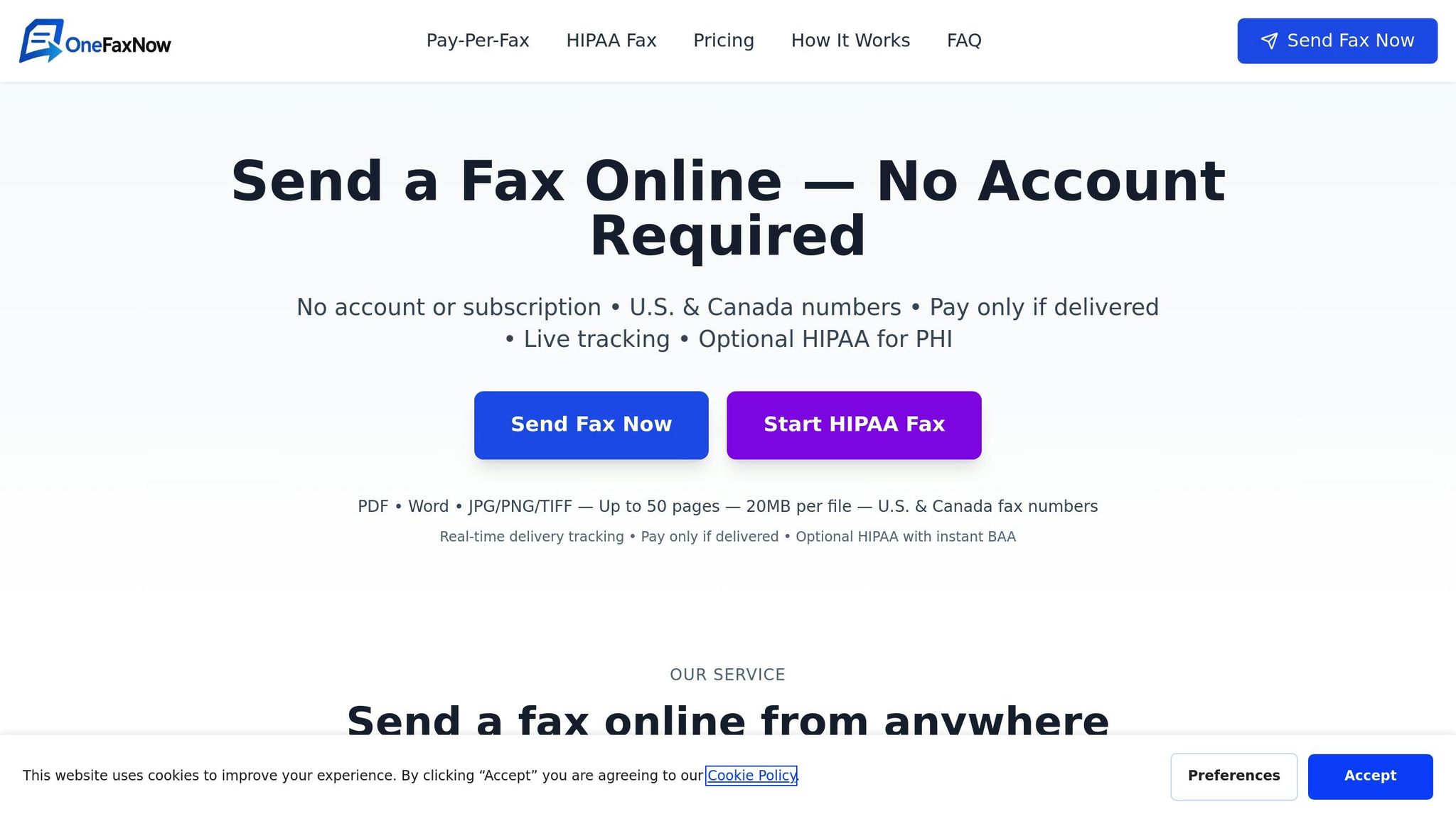
OneFaxNow addresses common challenges with its simple pay-per-fax pricing. You pay $3.50 for 1–10 pages or $5.00 for 11–50 pages, with no monthly fees or account setup required. For healthcare providers, the optional HIPAA mode adds a small fee and includes instant BAA execution via the dashboard.
The service meets industry encryption standards and provides real-time tracking with email updates to confirm delivery. Automatic retries (up to three attempts) ensure your fax gets through, and payment is only processed if the fax is successfully delivered - so you’re never charged for failed transmissions.
This model is ideal for tasks like sending medical records, insurance forms, court filings, or other sensitive documents without the burden of ongoing subscription costs. The ability to execute a BAA instantly makes OneFaxNow particularly appealing for healthcare providers who need to start sending HIPAA-compliant faxes without delay.
For organizations that send large volumes of faxes daily, subscription plans with unlimited usage might offer better value. But for those who fax occasionally - like a medical office forwarding records a few times a month, a legal firm filing court documents periodically, or a business submitting government forms - pay-as-you-go pricing eliminates waste and simplifies budgeting. Up next, learn how to maintain secure faxing practices across your organization.
How to Maintain Secure Faxing Practices
While encryption and compliance features are essential, maintaining secure faxing practices also requires strong internal policies. Technology can only do so much if your team isn’t following secure procedures. For industries like healthcare, legal services, and government agencies, clear protocols are critical to avoiding data breaches, unauthorized access, and compliance violations.
Create Fax Security Policies
Start by establishing clear fax policies. These should include requirements for cover pages that feature confidentiality statements and recipient details, as well as a process for verifying recipients against official records. Cover pages should clearly state the recipient’s name and fax number, along with instructions on how to handle misdirected faxes.
Physical security is equally important, especially if you’re still using traditional fax machines. Place these machines in secure areas where only authorized personnel can access incoming documents. Faxes containing sensitive information, such as PHI (Protected Health Information), should never be left unattended. Assign specific staff members to retrieve and distribute incoming faxes promptly, and make it a rule to log each transmission for auditing purposes.
For organizations using online fax services, your policies should outline who has access to the platform, how long documents are stored, and when they should be deleted. If your organization is subject to HIPAA regulations, ensure your policy aligns with the minimum necessary standard, meaning only the information required for the intended purpose is sent.
Make sure to document your fax policy and review it annually. Ensure all staff handling faxes have access to the policy, and require them to acknowledge in writing that they’ve read and understood the guidelines.
Train Staff on Secure Faxing
Technology and policies are only as effective as the people using them. Regular training is crucial to ensure your staff follows secure faxing practices.
Training should address common security risks tied to faxing. Teach employees how to identify misdirected faxes, spot unauthorized access attempts, and recognize social engineering tactics. For example, a healthcare worker might be targeted by someone posing as a physician requesting patient records, or a legal assistant could be asked to send court documents to an unverified number. Use real-world examples relevant to your industry to drive the message home.
It’s also important to highlight the consequences of non-compliance. In fields like healthcare, legal, and government work, breaches can result in hefty fines, legal action, and professional repercussions. When employees understand what’s at stake, they’re more likely to follow established protocols.
Training should be hands-on and ongoing. New hires need thorough onboarding that covers fax security procedures, while existing employees should receive annual refresher courses. If policies change or new threats arise, schedule additional sessions. Short, quarterly reminders can also help keep security top of mind.
Incorporate practical exercises into training. Let staff practice verifying recipients, responding to suspicious requests, and handling misdirected faxes. Role-playing scenarios can be especially effective in building confidence and reinforcing proper procedures.
Be sure to document all training sessions, including attendance and topics covered, to create an audit trail that demonstrates your organization’s commitment to secure practices.
Transition to HIPAA-Compliant Online Fax Services
Traditional fax machines come with security risks that are hard to ignore. Switching to a secure online fax service can minimize these risks while boosting efficiency and compliance.
Start by evaluating your faxing needs. Choose a provider that offers robust encryption - such as 256-bit AES for stored documents and TLS 1.2+ for transmissions - along with HIPAA compliance and the ability to execute a Business Associate Agreement (BAA). If you handle PHI, ensure the provider allows you to instantly execute a BAA through their platform.
Data residency is another factor to consider, especially if your organization must comply with specific regulations. Some providers let you choose where your data is stored, whether in the United States, Canada, or Switzerland, to meet local legal requirements.
Before fully transitioning to an online service, train your staff on the new platform. Even the most user-friendly systems require some orientation, particularly for employees accustomed to traditional fax machines. Provide quick-reference guides and designate a go-to person for technical questions to make the shift smoother.
Moving to online faxing isn’t just about improving security - it’s about creating a scalable, compliant communication system that meets your organization’s needs. Whether you’re a small practice sending a few records or a government agency managing hundreds of forms weekly, modern fax services offer the flexibility and transparency that traditional methods simply can’t match.
Conclusion
Secure faxing has become a critical tool for industries like healthcare, legal, and government sectors, where safeguarding sensitive data isn’t just a priority - it’s a necessity. By employing encryption, adhering to HIPAA standards, and implementing strong internal protocols, organizations can protect themselves from hefty fines, legal troubles, and potential harm to their reputation.
Modern online fax services take security seriously, using 256-bit AES encryption for document storage and TLS 1.2+ encryption for data transfers. These measures ensure compliance with stringent regulations such as HIPAA, SOC 2, ISO 27001, GDPR, and CCPA.
When selecting a digital fax provider, look for clear compliance features like instant BAA (Business Associate Agreement) execution and straightforward pricing. For those managing Protected Health Information, HIPAA mode with stricter protocols is non-negotiable. Additionally, data residency options - storing faxes in locations like the United States, Canada, or Switzerland - can be crucial for meeting local legal requirements.
OneFaxNow stands out with its no-commitment, pay-per-fax model. Send 1–10 pages for $3.50 or 11–50 pages for $5.00. Need HIPAA compliance? Add HIPAA mode for $3.00 (Lite) or $5.00 (Standard), which includes instant BAAs, audit-ready handling, and real-time tracking. Plus, you only pay when your fax is successfully delivered, with automatic retries included.
Whether it’s medical records, legal documents, insurance claims, or FOIA requests, OneFaxNow blends security, compliance, and ease of use into a single platform. These features not only meet regulatory demands but also simplify daily operations, making modern online faxing a must-have for regulated industries.
Send a HIPAA Fax Online - No Account Required
FAQs
How do traditional fax machines and online fax services differ in terms of security?
Traditional fax machines send documents over phone lines, which can be vulnerable if the line is compromised. On top of that, physical fax machines often leave sensitive information out in the open, accessible to anyone nearby.
Online fax services provide a much more secure alternative. They use encryption protocols to protect data during transmission, making it significantly harder for anyone to intercept. Many of these services also include advanced security features like password-protected access, audit trails, and compliance with regulations like HIPAA - essential for industries such as healthcare. That said, it’s crucial to select a trustworthy provider, as weak encryption or unsecured storage can still pose risks.
How does a Business Associate Agreement (BAA) help ensure HIPAA compliance when using digital fax services?
A Business Associate Agreement (BAA) is a legal contract that ensures digital fax service providers handle protected health information (PHI) in line with HIPAA requirements. It spells out the provider's responsibilities, such as securing data, preventing unauthorized access, and promptly reporting any breaches.
When a fax service provider signs a BAA, they officially become a Business Associate under HIPAA. This means they must adhere to strict privacy and security standards, including using encryption, secure transmission methods, and proper data storage to safeguard sensitive information. Without a BAA in place, using a digital fax service for PHI could lead to HIPAA violations and hefty penalties.
Why is encryption critical for secure digital faxing, and what features should I prioritize in a fax service?
Encryption plays a key role in keeping sensitive data safe when sending or receiving digital faxes. It protects your information during transmission and storage, helping to prevent unauthorized access and potential data breaches.
When selecting a fax service, look for providers that use 256-bit AES encryption to secure stored documents and TLS 1.2 or higher for data transfers. These protocols are widely recognized for their ability to defend against modern security threats. If you're dealing with sensitive materials - like medical or legal records - make sure the provider complies with standards such as HIPAA to ensure proper data protection.