Small Medical Practice Guide: When You Still Need to Fax in 2025
In 2025, faxing remains essential for small medical practices, ensuring secure communication amidst digital health advancements.
Small Medical Practice Guide: When You Still Need to Fax in 2025
In 2025, faxing remains a key tool for small medical practices in the U.S., despite advancements in digital health systems. Why? Many healthcare providers still rely on fax for secure and compliant communication, particularly when dealing with insurance forms, referrals, lab results, and legal documents. Here's why faxing persists and what you need to know:
- HIPAA Compliance: Faxing offers secure transmission of Protected Health Information (PHI) with modern online fax services meeting strict encryption and privacy standards.
- Interoperability Gaps: Many systems in healthcare still can't fully integrate, making faxing a reliable bridge for communication.
- Ease of Use: Faxing is straightforward and doesn't require complex IT setups, making it ideal for smaller practices.
- Online Fax Services: Modern platforms like Fax.Plus and OneFaxNow enhance security and convenience, offering options like digital signatures and real-time tracking.
For small practices, choosing the right fax service - whether pay-per-fax or subscription-based - ensures secure, cost-effective communication while meeting legal requirements.
How Faxing Fits Into U.S. Healthcare Systems
The U.S. healthcare system is a complex web of providers, insurers, and patients, making faxing an enduring part of communication - even as digital solutions gain traction. Many smaller medical practices continue to rely on fax for critical exchanges, bridging the gap between traditional workflows and the push toward electronic records. This reliance highlights the ongoing role of fax in maintaining communication during the shift to digital systems.
CMS Interoperability Timeline and Fax as a Bridge Solution
For years, federal agencies have been working to improve interoperability in healthcare, aiming for seamless data sharing across systems. Despite these efforts, the adoption of advanced electronic systems remains uneven. While some organizations have embraced fully digitized workflows, many smaller practices, rural clinics, and specialty providers still use legacy systems. In these cases, faxing acts as a dependable bridge, ensuring secure communication between different setups. These legacy workflows emphasize why fax remains a practical tool in healthcare.
When Medical Practices Use Fax
Faxing continues to play a vital role in several key areas of healthcare communication, especially for smaller practices. Here are some examples:
- Insurance prior authorizations: Many insurers still require paper-based forms for medication approvals or specialized treatments. Faxing facilitates the back-and-forth exchange of these documents.
- Specialist referrals: Patient records, test results, and referral forms are often sent via fax when providers operate outside a practice's internal network.
- Laboratory and imaging results: Some smaller labs rely on fax to send urgent or routine results directly to physicians.
- Pharmacy and government communications: Fax supports tasks like prior authorization requests, prescription clarifications, and administrative submissions to entities like health departments or Medicare contractors.
Modern online fax services provide HIPAA-compliant transmission, ensuring that sensitive patient information is handled securely [1].
"Our products are designed with top-tier security and privacy at their core. We're dedicated to meeting key certifications and compliances like SOC 2, HIPAA, ISO 27001, GDPR, and CCPA, ensuring our solutions align with global standards." - Fax.Plus [1]
This emphasis on security ensures that faxing remains a safe and reliable method for transmitting sensitive medical data, even in an increasingly digital landscape.
HIPAA Compliance for Medical Practice Faxing
The Health Insurance Portability and Accountability Act (HIPAA) lays out strict rules for managing Protected Health Information (PHI). When faxing patient data, medical practices must implement robust safeguards to ensure sensitive information stays secure. For smaller practices, following these rules is crucial to avoid costly penalties while maintaining secure communication with patients.
HIPAA Requirements for Faxing Protected Health Information (PHI)
HIPAA outlines three key safeguards for faxing PHI:
- Administrative safeguards: These include having written faxing policies, providing staff training, and maintaining detailed audit trails to track fax activity.
- Physical safeguards: Fax machines should be placed in secure, restricted areas, ensuring received faxes aren’t left unattended where unauthorized individuals could access them.
- Technical safeguards: Modern online fax platforms enhance security through advanced encryption methods like 256-bit AES for storage and TLS 1.2+ for data transfers. These services also use access controls - often managed through admin panels - to restrict who can send, receive, or view PHI. Additionally, options for storing data in specific regions (e.g., the United States, Canada, or Switzerland) help meet local legal requirements [1].
Now, let’s look at how traditional fax machines and online fax services compare in meeting these compliance needs.
Traditional Fax Machines vs. Online Fax Services
Understanding HIPAA safeguards highlights the stark difference between traditional fax machines and online fax services. Traditional fax machines fall short of compliance standards. They rely on unencrypted analog phone lines, leaving PHI vulnerable during transmission. Additionally, physical output trays can expose sensitive documents to unauthorized individuals.
Online fax services, on the other hand, address these vulnerabilities with secure encryption for both stored data and transmissions. Instead of relying on physical controls, they implement digital access management. Many online platforms even allow users to sign documents digitally within the faxing process, eliminating extra steps that could risk PHI exposure.
Fax.Plus is designed for simplicity, offering features like one-touch digital signing. It ensures security by adhering to both HIPAA and PCI protocols [1].
Online Fax Service Comparison for Small Medical Practices
Given faxing's ongoing role in safeguarding Protected Health Information (PHI), selecting the right online fax service is essential for small medical practices. The right choice ensures smooth patient communication and compliance without breaking the bank.
What to Look for in Online Fax Services
Pricing matters for small practices. If your office only occasionally sends referrals or insurance forms, a pay-per-fax model might be the way to go. For practices with higher faxing needs, subscription plans often save money in the long run. Be sure to check for any hidden fees, like setup charges or penalties for exceeding page limits.
HIPAA compliance is a must when dealing with PHI. Look for services offering Business Associate Agreements (BAAs), audit trails, and strong encryption for both stored and transmitted data. Some providers include these features in their base pricing, while others charge extra.
Ease of use during urgent situations is another consideration. If a service requires you to create an account before sending a fax, it could cause delays when time-sensitive documents need to go out. Services that let you fax without an account can save valuable time.
Delivery tracking ensures reliability. Features like real-time status updates, automatic retries, and success-only billing help avoid failed transmissions and unnecessary costs. Email notifications with tracking links can also provide peace of mind.
File compatibility is key. Your chosen service should support common formats like PDF, DOCX, TIFF, and JPEG. Keep in mind that page limits can vary widely between providers, so check if the service meets your needs.
The table below compares several top online fax services based on these essential criteria.
Side-by-Side Comparison of Top Online Fax Services
| Service | Pricing Model | 1–10 Pages | 11–50 Pages | HIPAA Compliance | Account Required | File Support | Delivery Tracking |
|---|---|---|---|---|---|---|---|
| OneFaxNow | Pay‑per‑fax | $3.50 | $5.00 | Optional add-on (+$3/$5) | No | PDF, DOCX, TXT, JPG, PNG, TIFF | Real‑time tracking, retries, success-only |
| eFax | Subscription | $16.95/mo | $16.95/mo | Available with BAA | Yes | PDF, DOC, TXT, JPG, GIF, TIFF | Email notifications |
| Fax.Plus | Subscription | $6.99/mo | $6.99/mo | HIPAA‑compliant | Yes | Multiple formats supported | Email tracking via mailbox |
| iFax | Subscription | $8.99/mo | $8.99/mo | Available with setup fee | Yes | PDF, DOC, JPG, PNG | Basic email updates |
| SRFax | Subscription | $9.95/mo | $9.95/mo | HIPAA‑compliant plans | Yes | PDF, DOC, TXT, TIFF | Email confirmations |
Last verified: November 6, 2025
Fax.Plus stands out for its strong encryption practices, using 256-bit AES for stored files and TLS 1.2+ for transfers. It also offers data residency options across 20 regions, including the U.S., which is helpful for practices with specific compliance needs.
OneFaxNow, on the other hand, shines for its simplicity and flexibility. Its no-account system allows immediate faxing of urgent documents like referrals or insurance forms. The success-only billing model ensures you only pay when the fax is successfully delivered, and automatic retries (up to three attempts) enhance reliability.
For small practices that need to send occasional faxes, OneFaxNow's pay-per-fax model avoids the recurring costs of subscription plans. The optional HIPAA mode, priced at $6.50 for 1–10 pages and $10.00 for 11–50 pages, includes instant BAA generation and compliance tools, making it easier to meet regulatory requirements.
Subscription services, like those offered by Fax.Plus or SRFax, are better suited for practices with frequent faxing needs. At $6.99 per month, Fax.Plus includes extras like a 30-day trial of Sign.Plus for digital signatures, which can simplify document workflows.
In contrast, traditional in-store faxing at places like FedEx or UPS may seem convenient but often comes with drawbacks. These services charge per page, lack integrated HIPAA compliance, and require staff to leave the office, potentially exposing sensitive information and disrupting workflows.
For practices that prioritize quick, low-volume faxing without the hassle of subscriptions, OneFaxNow is a standout option. Its flexibility and straightforward pricing make it a practical choice for small medical offices.
sbb-itb-0df24da
Why OneFaxNow Works Best for Small Medical Practices
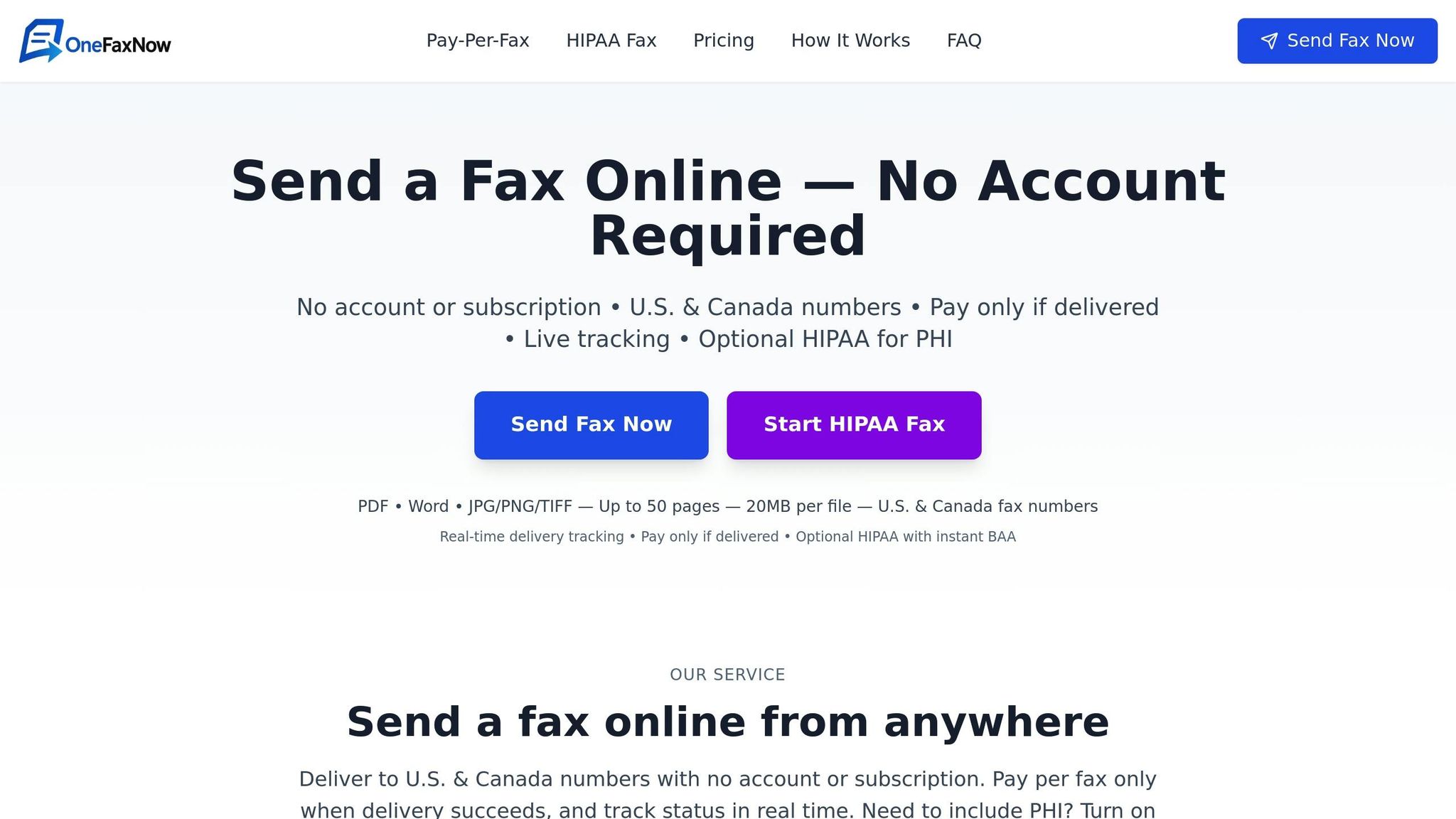
Small medical practices often need a faxing solution that’s straightforward, secure, and budget-friendly - without the hassle of complicated systems or recurring fees. OneFaxNow delivers exactly that, offering features tailored to healthcare providers who prioritize simplicity and cost control.
Key Benefits for Medical Practices
Instant access, no account setup required. When time is critical - like during an emergency referral or insurance pre-authorization - OneFaxNow lets you send a fax in under 60 seconds. No delays, no setup process.
Pay-as-you-go pricing saves money. Unlike subscription-based services like Fax.Plus, which starts at $6.99 per month [1], OneFaxNow charges only when you send a fax. This eliminates ongoing costs, making it a smarter choice for practices that fax occasionally.
Simplified HIPAA compliance. With the HIPAA mode, meeting compliance requirements is easy. Just select this option to automatically generate a Business Associate Agreement via your compliance dashboard, ensuring your practice stays within legal guidelines.
Support for multiple file types. Whether it’s a PDF, DOCX, TXT, JPG, PNG, or even a TIFF file, OneFaxNow handles it all - up to 50 pages or 20 MB per fax. No need for tedious file conversions, whether you’re sending quick notes or detailed medical records.
Only pay for successful transmissions. Thanks to three automatic retry attempts, you’re only billed for faxes that are successfully delivered, protecting your budget from unnecessary charges.
Secure payments through Stripe. With Stripe managing transactions, your financial information stays safe. You can use major credit cards, Apple Pay, or Google Pay with confidence.
These features aren’t just theoretical - they bring real-world advantages to the everyday operations of small medical practices.
Best Use Cases for OneFaxNow
Here’s how these benefits translate into practical solutions for common scenarios in healthcare:
Transferring medical records. When patients move to a new provider or need a specialist, OneFaxNow’s HIPAA mode ensures secure, compliant transmission. Real-time tracking and audit trails provide added peace of mind.
Submitting insurance pre-authorizations and claims. OneFaxNow’s automatic retry system helps prevent lost submissions due to temporary errors, while tracking links confirm delivery - critical for avoiding delays in patient care.
Handling court-ordered medical records and legal documents. With transparent, pay-per-fax pricing, you can quickly respond to urgent legal requests without worrying about subscription limits or extra fees.
Sending emergency referrals. Need to send patient records to a specialist while they’re still in your office? OneFaxNow’s speed and ease of use let you upload files, add a cover page, and send the fax in minutes. Email confirmations and tracking links ensure nothing falls through the cracks.
FOIA requests and government communications. OneFaxNow’s broad file support and success-only billing make it a reliable choice for sending documents to government agencies or fulfilling Freedom of Information Act requests.
With its transparent pricing, instant accessibility, and healthcare-specific compliance features, OneFaxNow is perfectly suited for small practices looking for a reliable faxing solution without the complexity of larger systems.
Conclusion: Fax Remains Practical for 2025 Healthcare
Even with the rise of digital records, fax continues to play a crucial role in the U.S. healthcare system. Many providers still rely on fax to securely transmit sensitive documents, making it an indispensable tool as the industry works toward full digital integration.
Modern online fax services have adapted to meet today’s needs, incorporating features like advanced encryption and digital signing to ensure compliance with healthcare regulations while simplifying workflows [1]. Verified as of October 25, 2023.
For smaller practices, pay-per-fax solutions like OneFaxNow offer a cost-effective and compliant alternative. These services eliminate the need for monthly subscriptions, allowing practices to securely send urgent, HIPAA-compliant faxes only when necessary. With transparent pricing and features tailored to healthcare, small medical offices can handle critical communications without the burden of complex systems or long-term commitments.
In 2025, the key to effective healthcare communication lies in choosing the right faxing solution. Until the industry fully transitions to digital systems, small practices need secure, affordable, and regulation-compliant fax options that integrate seamlessly into their current workflows while supporting future digital advancements.
Why Choose OneFaxNow for Medical Practices:
OneFaxNow offers no-account, pay-per-fax pricing combined with advanced security and HIPAA-compliant features. It’s perfect for sending one-time medical records, insurance forms, referrals, or even court documents.
Primary CTA: Send a Fax Online - No Account Required
Secondary CTA: Learn more about our HIPAA-compliant faxing options for secure communication.
FAQs
Why might small medical practices still rely on faxing in 2025, even with modern digital health systems?
Despite progress in digital health systems, many small medical practices still rely on faxing as a practical workaround. This is largely because the CMS interoperability timelines, which aim to create standardized systems for digital health data sharing, are still a work in progress. Until those standards are fully implemented, faxing offers a dependable way to securely exchange patient information with other providers, insurers, and government agencies.
On top of that, faxing helps practices maintain compliance with HIPAA regulations when using tools like OneFaxNow’s optional HIPAA mode. This mode includes stricter data handling protocols and immediate execution of a Business Associate Agreement (BAA). For smaller practices, faxing remains an affordable and accessible solution for managing sensitive information while they navigate the shift to fully digital systems.
How do online fax services help small medical practices stay HIPAA compliant?
Online fax services help healthcare providers meet HIPAA requirements by offering features designed to safeguard sensitive patient data. These include an optional HIPAA mode with enhanced security measures, the ability to quickly sign a Business Associate Agreement (BAA), and audit-ready tools like secure storage and detailed activity logs.
For smaller medical practices, these features make it easier to comply with regulations while maintaining the confidentiality and integrity of patient information.
What should small medical practices look for in an online fax service?
When choosing an online fax service, small medical practices need to prioritize features that align with their operational needs and compliance requirements. Cost considerations should be at the top of the list - compare pay-per-fax services with subscription plans to determine which is more cost-effective for your page volume. Be sure to check for any hidden charges that could inflate your expenses unexpectedly.
Compliance is another critical factor. The service must include HIPAA-friendly features, such as an optional HIPAA mode, availability of a Business Associate Agreement (BAA), and secure storage practices to safeguard sensitive patient information.
User-friendliness is equally important. Opt for services that simplify the process, such as those that don’t require an account to send a fax, allow for easy checkout using Apple Pay or Google Pay, and provide clear delivery tracking. Features like real-time status updates, automatic retries, and refunds for failed transmissions can save time and reduce frustration. Also, ensure the service supports commonly used file formats like PDFs, DOCX, and image files, and verify that page limits are reasonable for your needs.
For peace of mind, look for providers that offer audit logs, compliance documentation, and transparent policies for handling sensitive information. These features can help ensure your practice remains efficient and compliant.