How Small Practices Can Handle Low-Volume Faxing Without a Long-Term Contract
Save money on occasional faxes: compare pay-per-fax vs subscriptions, learn HIPAA-compliant options, and see when each fits small practices.
How Small Practices Can Handle Low-Volume Faxing Without a Long-Term Contract
Are you paying too much for faxing you barely use? Small practices often send fewer than 20 faxes a month, yet traditional fax solutions - like physical machines or subscriptions - charge for capacity you don’t need. Here’s the bottom line:
- Fax machines: Cost ~$40–$60/month for a phone line, plus toner and maintenance.
- Subscriptions: Start at $6.99/month, totaling ~$84/year - even if you send just a few faxes.
- Pay-per-fax services: Charge only for what you send, costing $3.50–$6.50 per fax, saving you money for low-volume needs.
Quick takeaway: If you fax occasionally, pay-per-fax options like OneFaxNow can cut costs and avoid unnecessary commitments. For frequent faxing or receiving, a subscription may make more sense. Let’s break it down further.
How Much Do Small Practices Actually Fax?
Solo providers and small clinics usually send between 5 and 15 faxes per month [1][2]. With such a low volume, traditional fax solutions - whether physical machines or subscription-based services - often don’t make financial sense. You end up paying for capacity you rarely use. This raises an important question: why are faxes still so essential, even when used infrequently?
Common Reasons Small Practices Send Faxes
For small practices, faxing is typically reserved for a few key tasks. These include handling prior authorizations for medications or procedures, sending referrals to specialists, and responding to requests for medical records from other providers or patients. While these tasks may not happen daily, they’re critical to operations. Because of this, even small inefficiencies in fax-related costs can have a noticeable impact on a practice's budget.
Why Low Volume Affects Costs
When your faxing needs are minimal, the economics shift. Traditional fax machines come with fixed costs - like a dedicated phone line, equipment, toner, and the time staff spends managing them. So, even if you’re only sending a handful of faxes each month, you’re still paying for these ongoing expenses.
Subscription-based fax services can be equally problematic. Take Fax.Plus, for instance: its Individual plan costs $6.99 per month [3], whether you send one fax or twenty. For a practice sending just five prior authorizations a month, this adds up to about $83.88 annually. Compare that to a pay-per-fax model, where you might spend around $3.50 for standard faxes and $6.50 for HIPAA-compliant ones. Over the course of a year, this could range from $17.50 to $32.50 for five faxes a month - significantly less than a subscription, with charges only applied to successfully sent faxes.
What Traditional Fax Solutions Actually Cost

Annual Faxing Costs Comparison: Fax Machine vs Subscription vs Pay-Per-Fax for Low-Volume Practices
When it comes to faxing, the real costs often go beyond the obvious monthly fees. Whether you’re using a traditional fax machine or a subscription service, hidden expenses can sneak up on you - especially if your faxing needs are minimal. Let’s break down these costs to see where your money might be going.
Fax Machines: Equipment, Phone Lines, and Staff Time
Owning a fax machine isn’t just about the initial hardware purchase. You’ll also need to budget for phone line fees, supplies like paper and toner, and the time spent maintaining the machine. These costs don’t disappear, even if you only send a handful of faxes each month. For example, if your practice sends just five faxes monthly, you’re still on the hook for ongoing phone line charges and other recurring costs that add up over time.
Subscription Services: Paying for What You Don’t Use
Subscription plans, such as the Fax.Plus Individual plan priced at $6.99 per month [3], charge you a flat rate whether you send one fax or a hundred. That means you’re paying $83.88 annually, even if you only send five faxes a month. These plans are typically designed for higher-volume users, making them less practical for low-volume needs. Essentially, you're paying for capacity you don’t use.
Cost Comparison: Fax Machine vs. Subscription vs. Pay-Per-Fax
Here’s a quick look at how the costs stack up for low-volume faxing, assuming five faxes per month:
| Method | Upfront Cost | Monthly Cost | Annual Cost (5 faxes/month) | Staff Time |
|---|---|---|---|---|
| Fax Machine | Varies | Varies | Varies | Varies |
| Subscription (Fax.Plus) | $0 | $6.99 [3] | $83.88 | Minimal |
| Pay-Per-Fax (OneFaxNow) | $0 | $0 | $17.50–$32.50 [2][1] | Minimal |
For practices with minimal faxing needs, the pay-per-fax model stands out as the most cost-effective option. With OneFaxNow, you’re only charged when a fax is successfully delivered. Rates are $3.50 for standard faxes (1–10 pages) and $6.50 for HIPAA-compliant faxes [2][1]. Sending five faxes per month would cost you between $17.50 and $32.50 annually - a fraction of the cost compared to a traditional fax machine or subscription plan. This approach ensures you’re not paying for unused capacity, making it a smarter choice for low-volume users.
When to Choose a Subscription vs Pay-Per-Fax
Deciding between a subscription and a pay-per-fax service depends on how often you fax, the size of your documents, and whether you need to receive faxes. If you only send a few faxes occasionally, a pay-per-fax option like OneFaxNow can save you money. On the other hand, if you fax frequently or need a dedicated line for incoming documents, a subscription service might be the better fit. Here's a closer look at what to consider when making your choice.
What to Consider Before Choosing
Start by tracking how many pages you send each month, including cover pages, to get a clear picture of your faxing needs. If you’re handling sensitive information like PHI, make sure the service is HIPAA-compliant and offers a Business Associate Agreement (BAA) right away. For those who need inbound faxing or advanced features like integrations, a subscription service could be more practical. Pay-per-fax models, such as OneFaxNow, focus on outbound faxing, while subscription services like Fax.Plus provide features like dedicated fax numbers and multi-user support for a flat monthly rate.
Monthly Cost at Different Volume Levels
Here’s a breakdown of the monthly costs for HIPAA-compliant faxing with both models:
| Monthly Volume and Size | Fax.Plus Individual Subscription [3] | OneFaxNow (HIPAA Mode) [1] [2] | Advantage |
|---|---|---|---|
| 1 fax (1–10 pages) | $6.99 (flat rate) | $6.50 per fax | Pay-per-fax wins |
| 1 fax (11–50 pages) | $6.99 (flat rate) | $10.00 per fax | Subscription wins |
| 5 faxes (1–10 pages each) | $6.99 (flat rate) | 5 × $6.50 = $32.50 | Subscription wins |
| 20 faxes (1–10 pages each) | $6.99 (flat rate) | 20 × $6.50 = $130.00 | Subscription wins |
If you only send one small fax (1–10 pages) each month, the pay-per-fax model offers slight savings. However, for larger or more frequent faxing - or if you need inbound fax capabilities - a subscription service is generally more cost-effective and comes with added features. These comparisons make it clear when pay-per-fax is the better option. Now, let’s explore why OneFaxNow is a great choice for this use case.
Why Choose OneFaxNow for This Use Case?
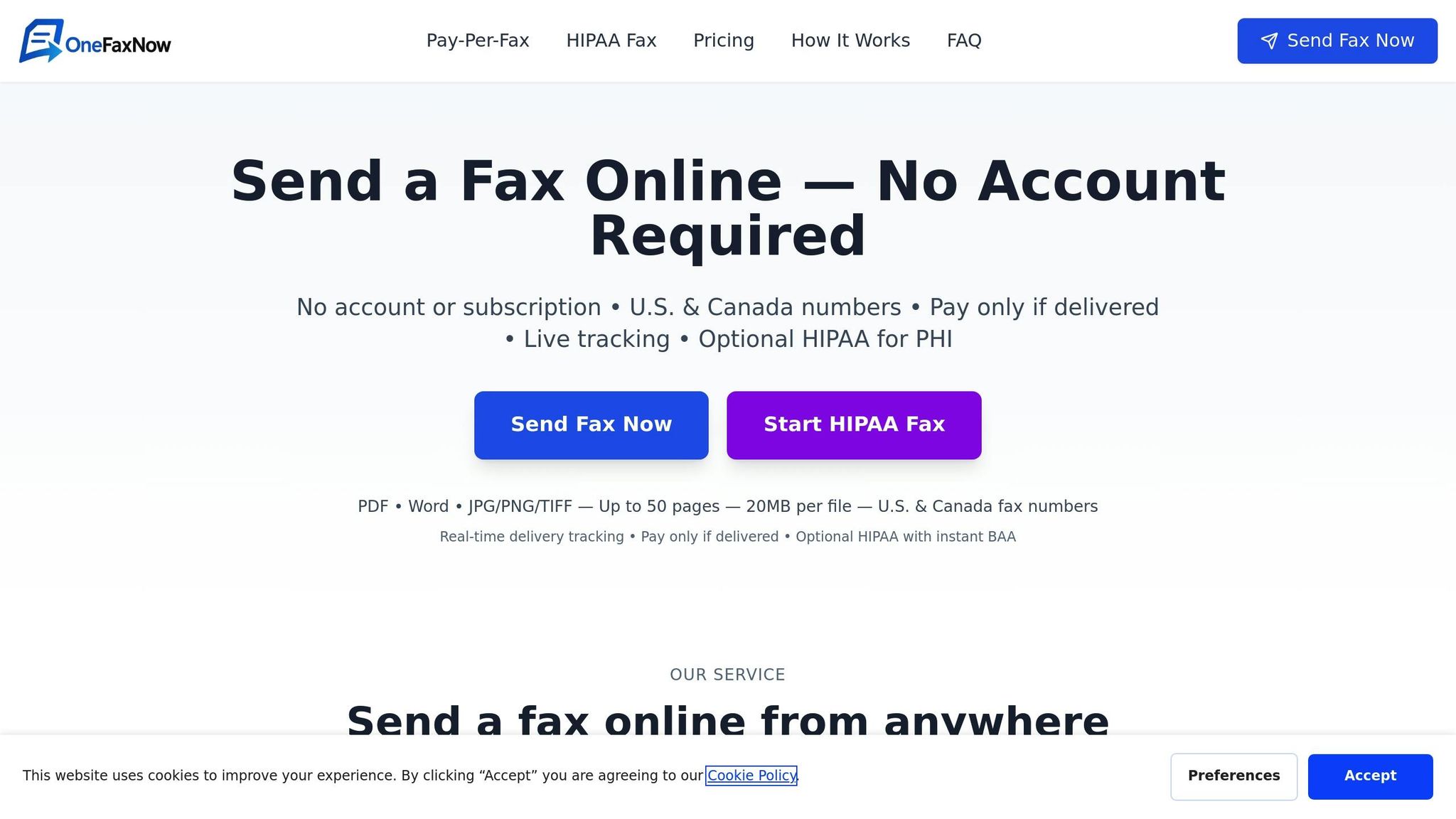
For those with occasional faxing needs and no interest in long-term commitments, OneFaxNow is a straightforward solution. You only pay for what you send, with no monthly fees. Its HIPAA mode includes instant BAA generation, encrypted transmissions, and audit logging, making it ideal for solo providers, small clinics, and office managers who primarily send documents like medical records, referrals, or insurance forms.
Ready to streamline your faxing?
Send a Fax Online - No Account Required
For more details on HIPAA-compliant faxing, visit our HIPAA Fax Explainer.
sbb-itb-0df24da
How OneFaxNow Works for Low-Volume Practices
OneFaxNow takes a fresh approach to faxing by eliminating the wasteful costs tied to traditional subscription models. Instead of locking you into monthly fees, it charges only when a fax is successfully delivered. There are no recurring charges, no contracts, and no account setup needed. Simply upload your document, type in the recipient’s fax number, add an optional cover page, and pay securely through Stripe. The best part? Payment is processed only if the fax is delivered successfully - if all retries fail, you won’t be charged 1.
Straightforward Per-Fax Pricing
For practices that send just a few faxes each month, OneFaxNow’s pay-as-you-go pricing makes perfect sense. Rates are $3.50 for 1–10 pages (Lite Plan) and $5.00 for 11–50 pages (Standard Plan). If you need HIPAA compliance, you can activate HIPAA Mode at checkout, which adjusts the rates to $6.50 (Lite) or $10.00 (Standard). There are no hidden fees, no minimum usage requirements, and no charges for failed attempts 1.
HIPAA Mode and Instant BAA Access
For those handling sensitive information, OneFaxNow’s HIPAA Mode ensures compliance every step of the way. When this mode is enabled, the service provides encryption during transmission and storage, deletes protected health information (PHI) immediately after delivery, and generates a Business Associate Agreement (BAA) for download upon successful transmission. It also offers a detailed audit trail with timestamps, which can be exported as CSV or PDF files. Unlike other services, drafts are not saved, and every action is logged for added security. Access to the HIPAA Audit Dashboard is provided via a secure, time-limited email link - no account creation required 1.
No Account Needed and Real-Time Tracking
OneFaxNow keeps things simple by not requiring an account. After sending a fax, you’ll receive an email with a real-time tracking link that updates you on the status of your transmission. If the fax encounters busy signals or temporary issues, the system automatically retries up to three times. Should all attempts fail, you’ll get a clear explanation of the failure, and your payment authorization will be canceled. This transparent process makes it a perfect fit for small practices with occasional faxing needs 1.
Comparing OneFaxNow to eFax, Fax.Plus, and SRFax
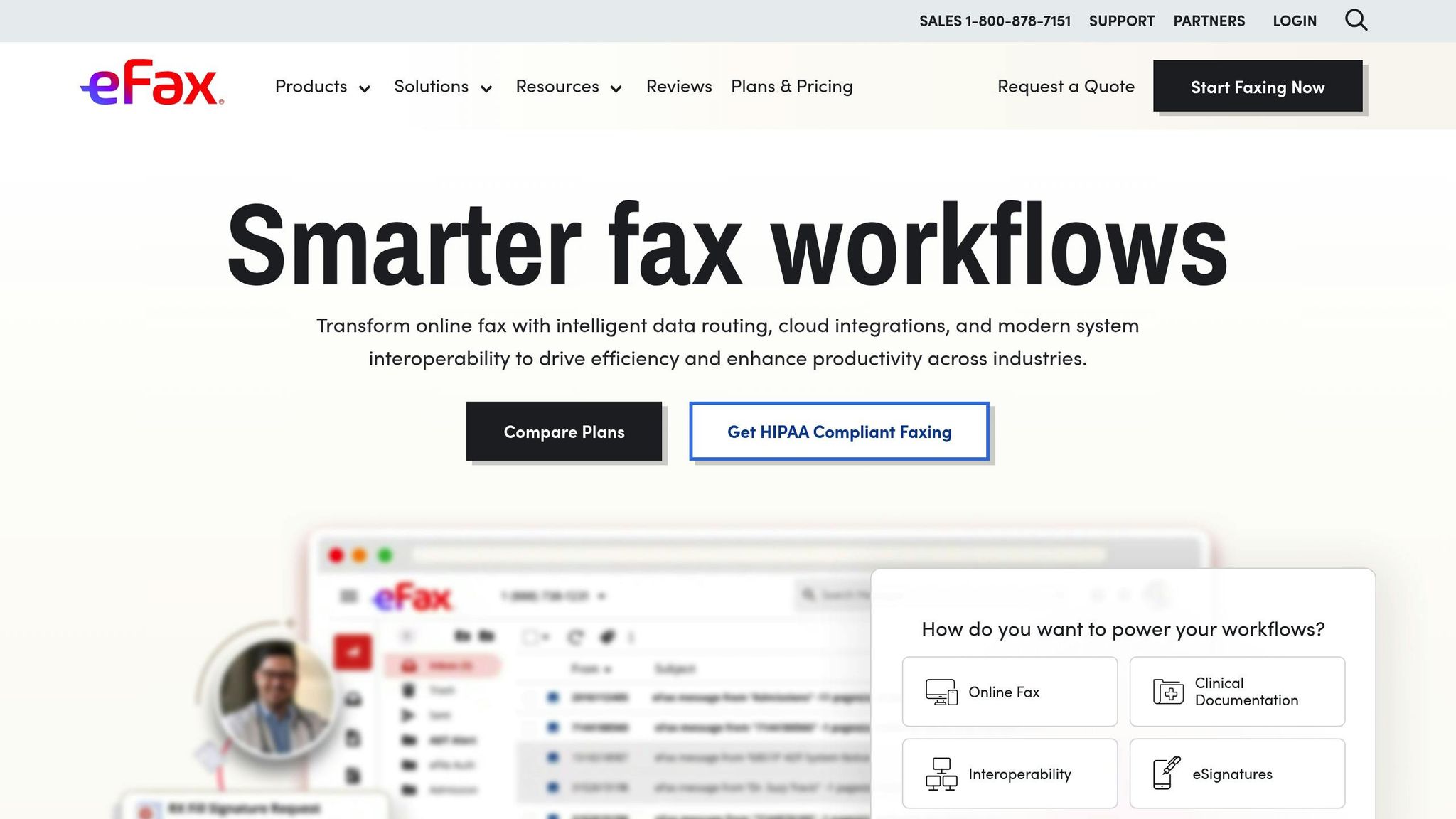
Here’s how OneFaxNow stacks up against other services for low-volume users:
| Feature | OneFaxNow | eFax | Fax.Plus | SRFax |
|---|---|---|---|---|
| Pricing Model | Pay-per-fax: $3.50 (1–10 pages), $5.00 (11–50 pages) | Subscription: from $16.95/month | Subscription: from $6.99/month | Subscription: from $9.95/month |
| HIPAA Mode Cost | +$3.00 (Lite) or +$5.00 (Standard) | Included in higher-tier plans | Included in all plans | Included in all plans |
| BAA Availability | Instant, fully executed at checkout | Available upon request | Available | Available upon request |
| Account Required | No | Yes | Yes | Yes |
| Payment Capture | Only on successful delivery | Charged monthly regardless of use | Charged monthly regardless of use | Charged monthly regardless of use |
| Automatic Retries | Three automatic retries | Not publicly stated | Not publicly stated | Not publicly stated |
| Audit Logs | Full audit trail with CSV/PDF exports | Available in higher tiers | Not publicly stated | Available |
| Best For | Sporadic, low-volume outbound faxing | High-volume or inbound needs | Mixed volume with inbound needs | Healthcare-focused practices |
For providers who send fewer than five faxes a month, OneFaxNow’s pay-per-fax model avoids the expense of unused subscription plans. However, if you require a dedicated fax number for receiving faxes or send over 10–15 faxes monthly, a subscription service like Fax.Plus or SRFax may be a better fit. OneFaxNow is especially ideal for solo practitioners, small clinics, or office managers who occasionally need to fax medical records, insurance forms, or referrals.
Ready to fax without a subscription?
Send a Fax Online - No Account Required
For HIPAA-compliant faxing with instant BAA access, check out our HIPAA Fax page. Learn more about our pricing and insurance claims use cases.
Choosing the Right Fax Method for Your Practice
Selecting the right fax method for your practice isn’t just about convenience - it’s about aligning with your faxing needs, volume, and compliance requirements. Let’s break it down.
What Small Practices Should Keep in Mind
If your practice sends fewer than 10 faxes a month, a pay-per-fax service could be your best bet. It’s ideal for practices focused mainly on outbound faxing while maintaining HIPAA compliance, all without the burden of recurring fees. In such cases, paying per fax is often cheaper than committing to a subscription.
On the other hand, if you regularly receive faxes or send more than 15–20 faxes monthly, a subscription service might make more sense. Options like Fax.Plus (starting at $6.99/month) and SRFax (from $9.95/month) not only handle inbound and outbound faxes but also offer extras like team management tools and international faxing. These features, while valuable, may not be necessary for smaller practices focused solely on sending faxes.
Here’s a straightforward way to decide which option fits your practice best.
3-Step Decision Guide
Step 1: Measure Your Monthly Outbound Fax Volume
Track the number of faxes you send over the course of a month. If it’s under 10, a pay-per-fax model will likely save you money. For volumes between 10 and 20, compare the costs of OneFaxNow’s per-fax rates with the monthly fees of subscription services.
Step 2: Check Your Compliance Needs
Make sure the service you choose complies with HIPAA standards. OneFaxNow simplifies this with its HIPAA Mode, which doesn’t require extra setup or an additional account.
Step 3: Decide If You Need to Receive Faxes
Think about whether receiving faxes is part of your workflow. If you need to accept documents from patients, labs, or insurance companies, a subscription service with a dedicated fax number is likely essential. However, if your practice is mostly sending referrals, records, or insurance forms, a pay-per-fax model is often the most efficient and cost-effective choice.
FAQs
How can small practices save money on low-volume faxing?
Small practices can cut costs by opting for a pay-per-fax service like OneFaxNow instead of locking into expensive subscription plans. With this approach, there are no monthly fees, no need to invest in hardware, and no maintenance expenses - just pay for each fax you send. This setup works especially well for practices with low faxing needs, like sending a handful of referrals or prior authorizations each month.
By removing unnecessary overhead and offering simple, per-use pricing, pay-per-fax services make a practical and cost-effective choice for small practices that don’t require a full-fledged fax line or subscription plan.
How does OneFaxNow keep medical faxes secure and HIPAA-compliant?
OneFaxNow takes the worry out of HIPAA compliance with its optional HIPAA mode, designed to securely handle Protected Health Information (PHI). This feature includes strong encryption, real-time tracking, and automatic retries to ensure your faxes are transmitted safely and reliably.
When you enable HIPAA mode, you can instantly create a Business Associate Agreement (BAA), giving you the assurance you need for compliance. Plus, the platform offers an audit-ready dashboard that lets you track fax statuses and maintain transparent records for regulatory purposes. It’s a simple and secure solution for sending medical faxes without the need for a subscription.
When does it make sense for a small practice to choose a fax subscription over pay-per-fax?
For smaller practices that consistently send between 10 and 50 pages of faxes each month, a subscription service could save money. With a fixed monthly fee, this option often proves more economical than paying for each fax individually.
On the other hand, if your faxing needs are minimal - like sending a few referrals, prior authorizations, or records here and there - pay-per-fax might be the way to go. It avoids the ongoing expense of a subscription and eliminates the need for maintaining fax hardware or a dedicated fax line.