How Much Does It Really Cost to Fax a 20-Page Packet at Retail Stores vs Online?
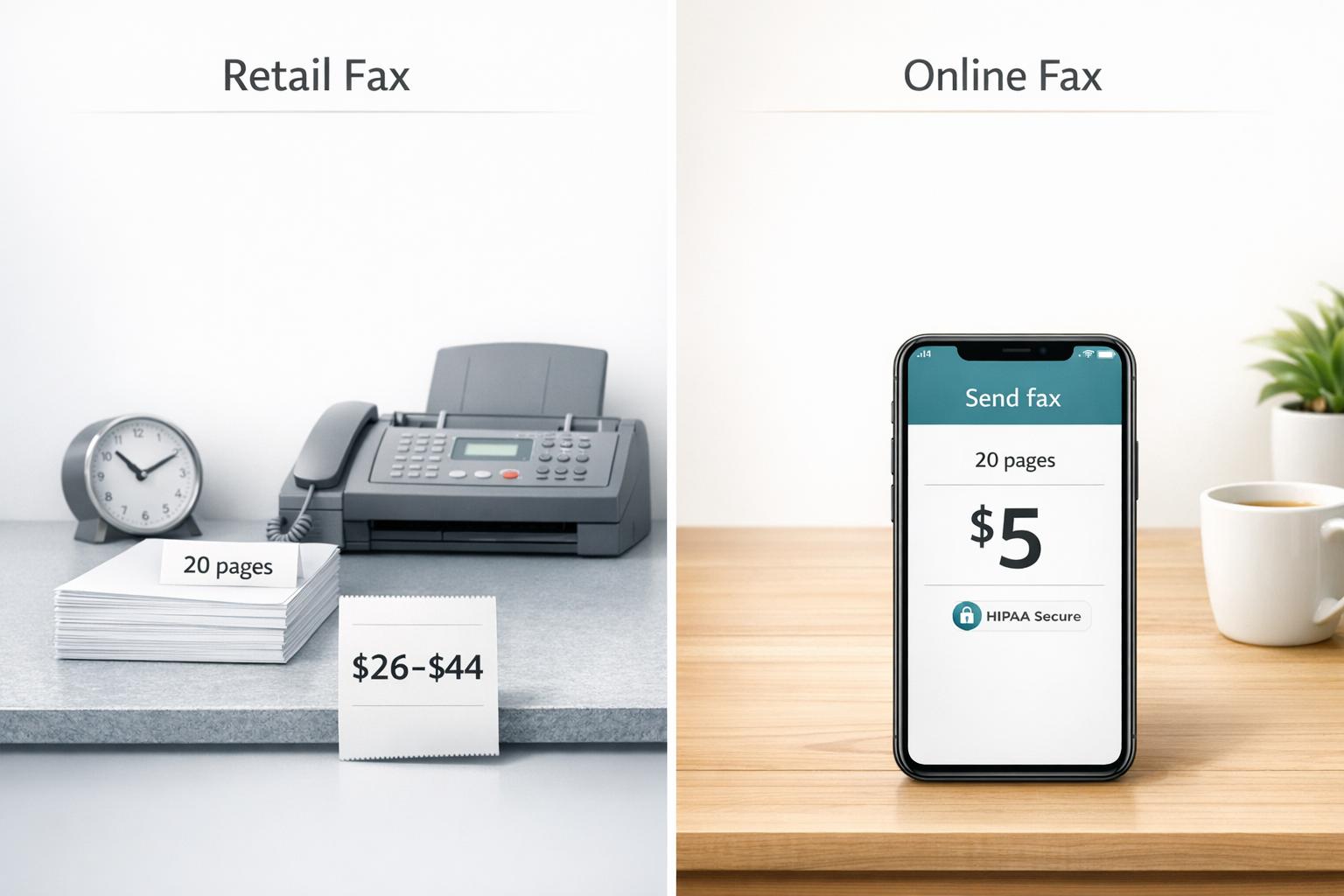
Compare true costs: faxing a 20‑page packet costs $26–$44 at retail stores vs $5 online, plus time and HIPAA security differences.
How Much Does It Really Cost to Fax a 20-Page Packet at Retail Stores vs Online?
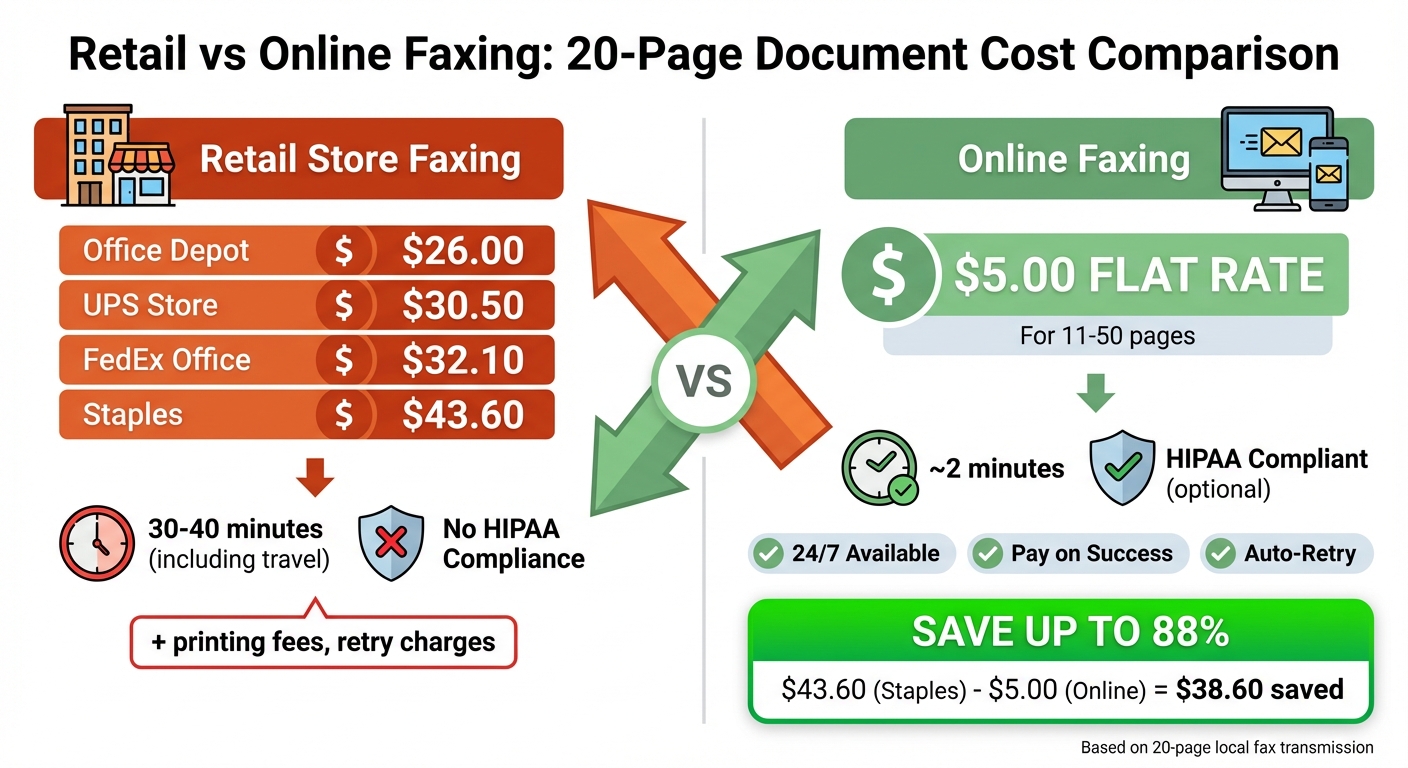
Faxing a 20-page document can cost significantly more at retail stores like FedEx, UPS, or Staples and Office Depot compared to online services. Retail locations typically charge $26–$44, depending on the provider and location, with extra fees for printing or retries. Online services, such as OneFaxNow, offer a flat rate of $5 for up to 50 pages, saving you up to 88%.
Key Points:
- Retail Costs: $26–$44 for 20 pages (plus potential extra fees).
- Online Costs: OneFaxNow charges $5 flat for 11–50 pages.
- Time & Convenience: Online faxing takes about 2 minutes, while retail faxing can take 30–40 minutes, including travel and waiting.
- Security: Online services like OneFaxNow offer optional HIPAA compliance for sensitive documents, unlike retail stores.
Quick Comparison
| Service | Cost for 20 Pages | HIPAA Compliance | Time Required |
|---|---|---|---|
| OneFaxNow | $5.00 | Yes (optional) | ~2 minutes |
| Office Depot | $26.00 | No | ~30–40 minutes |
| UPS Store | $30.50 | No | ~30–40 minutes |
| FedEx Office | $32.10 | No | ~30–40 minutes |
| Staples | $43.60 | No | ~30–40 minutes |
For cost, speed, and privacy, online faxing is the better choice, especially for large or sensitive documents.
Cost Comparison: Retail vs Online Faxing for 20-Page Documents
Retail Store Faxing Costs: FedEx, UPS, Staples, and Office Depot
Retail stores often use tiered pricing for faxing, where the first page costs more than the following ones. Additional fees for cover sheets, printing, or transmission retries can significantly impact the total cost of faxing a 20-page document. When evaluating alternatives, it's helpful to compare online fax pricing models like pay-per-fax versus subscriptions. Cover sheets, which are often mandatory, are typically counted as an extra page[6]. In franchised locations like The UPS Store, prices may vary by up to 20% depending on the specific owner[1].
Here’s a closer look at what you might pay for a 20-page local fax at some of the most popular retail outlets:
FedEx Office: Cost Breakdown
FedEx Office has a straightforward pricing structure for local and national faxes:
- Local Faxes: The first page costs $1.89, with $1.59 per additional page. For 20 pages, this totals approximately $32.10.
- National Faxes: Sending a fax to another state costs $2.49 for the first page and $2.19 for each additional page, bringing the total to about $44.10.
- Printing Fees: If you need to print your documents in-store, expect to pay an extra $0.15 to $0.25 per page, adding $3.00 to $5.00 to your total cost[2][3].
UPS Store: Cost Breakdown
Prices at The UPS Store can vary depending on the location. Most stores charge between $1.00 and $2.00 per page for both local and national faxes[1][3]. For a 20-page document, this means you could spend anywhere from $20.00 to $40.00. Be aware that some locations charge for every transmission attempt, so a failed fax due to a busy line could double your costs.
Staples and Office Depot: Cost Breakdown
- Staples: The cost is about $2.00 for the first page and $2.20 for each additional page, which totals $43.80 for 20 pages[2][3].
- Office Depot: Offers a lower rate of $1.49 for the first page and $1.29 for each subsequent page, adding up to around $26.00 for 20 pages[1].
- Digital Files: Both Staples and Office Depot require physical documents for faxing. If you’re faxing from a digital file, additional printing fees of $0.10 to $0.20 per page will apply[2][3].
sbb-itb-0df24da
Online Faxing Costs: OneFaxNow as an Alternative
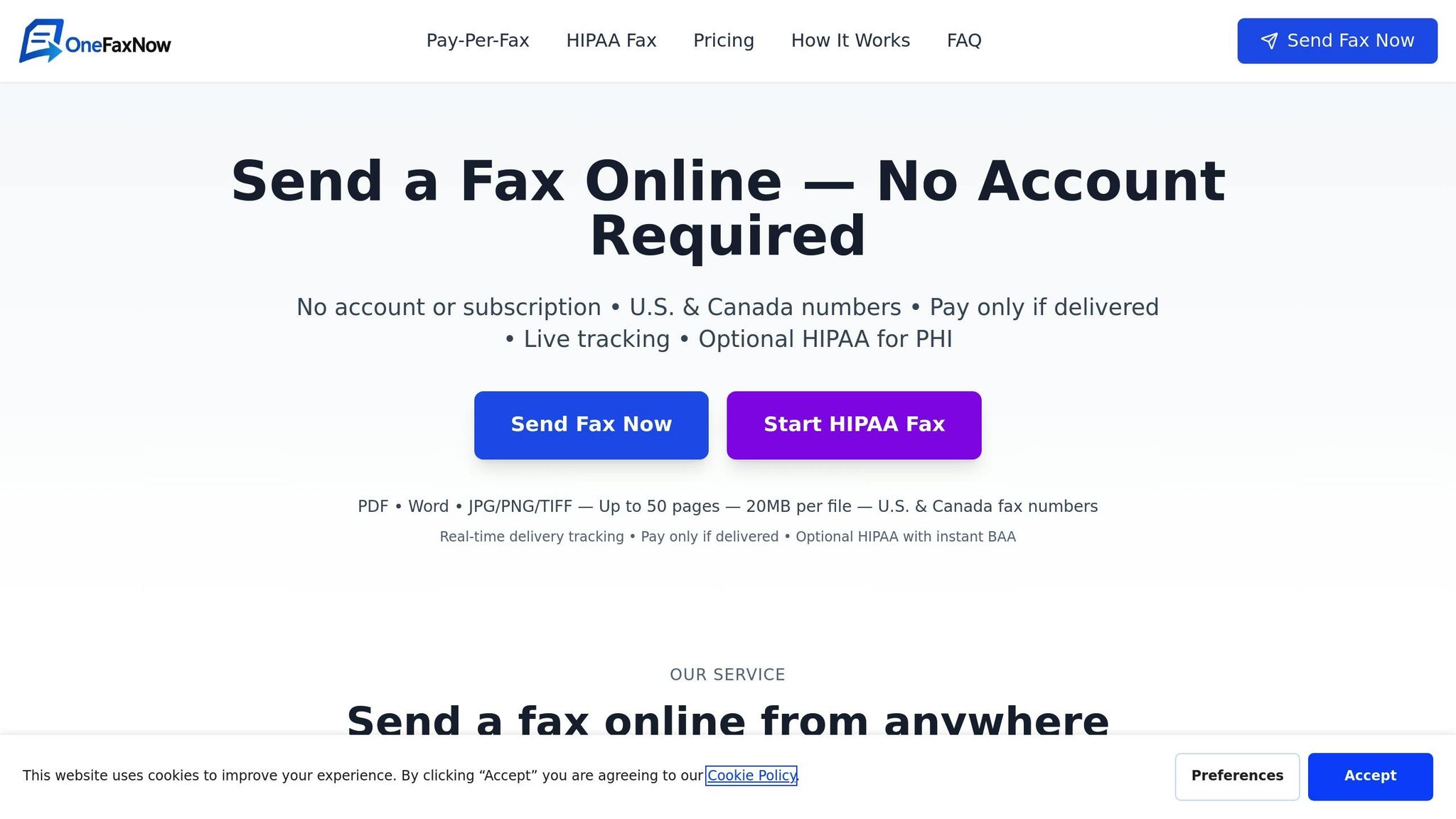
Online faxing eliminates the hassle of travel, printing, and waiting in line. For a 20-page document - whether it’s an insurance claim, medical records, or a legal filing - OneFaxNow offers a flat rate of $5.00 for transmissions ranging from 11 to 50 pages. This pricing applies whether you’re faxing locally or across the country [7]. Let’s break down the pricing and explore the features that make OneFaxNow a standout choice.
OneFaxNow Pricing for 20-Page Faxes
OneFaxNow keeps things simple with its pay-per-fax model: $3.50 for 1–10 pages and $5.00 for 11–50 pages. There’s no need for a subscription or account. If you require extra security, the optional HIPAA Mode costs an additional $5.00. This feature includes encrypted transmissions, instant BAA access from your dashboard, and permanent audit logs [7].
One of the service’s standout benefits is its "pay on success" guarantee - you won’t be charged if your fax fails to deliver, even after multiple automatic retries. This is a big plus compared to retail faxing services, where you might be billed for every attempt, successful or not.
Key Features and Advantages
OneFaxNow isn’t just about cost savings. It’s packed with features designed for convenience and efficiency. The service supports a variety of file types, including PDF, DOCX, TXT, JPG, JPEG, PNG, TIF, and TIFF. You can upload files directly from your computer or phone, making it incredibly flexible.
If the recipient’s line is busy, OneFaxNow automatically retries up to three times. Plus, you’ll receive a real-time tracking link via email to monitor your fax’s status [7].
The entire process takes about 2 minutes, a stark contrast to the 40 minutes you might spend at a retail store factoring in travel and wait times [8]. Available 24/7, OneFaxNow also allows you to send faxes outside of normal business hours. For added privacy, digital encryption ensures no staff members handle your documents, and nothing is left behind on a public machine [6].
With these features, OneFaxNow offers a compelling alternative to traditional retail faxing, combining affordability, speed, and security.
Last verified: February 9, 2026
Retail vs Online: Side-by-Side Comparison
Cost Comparison Table
Sending a 20-page packet through online services versus retail locations highlights a sharp cost difference. Here's a breakdown:
| Service Provider | First Page (Local) | Additional Pages (Local) | Total Cost (20-Page Fax) | HIPAA Compliance |
|---|---|---|---|---|
| OneFaxNow | N/A (Flat Rate) | N/A (Flat Rate) | $5.00 | Yes (with BAA) |
| Office Depot | $1.49 | $1.29 | $26.00 | No |
| UPS Store | $2.00 | $1.50 | $30.50 | No |
| FedEx Office | $1.89 | $1.59 | $32.10 | No |
| Staples | $1.80 | $2.20 | $43.60 | No |
OneFaxNow's flat rate of $5.00 offers over 80% savings compared to the per-page pricing at retail locations[9]. For instance, sending a 20-page national fax with FedEx could cost about $44.10 (based on $2.49 for the first page and $2.19 for additional pages), while OneFaxNow keeps the rate steady at $5.00 for any destination across the U.S. or Canada[9]. Keep in mind, retail prices often exclude added expenses like gas, parking, or printing fees.
Why OneFaxNow stands out: For tasks like transmitting 20-page insurance or legal packets, OneFaxNow combines speed, security, and affordability into a flat-rate, HIPAA-compliant service.
This cost advantage is just the start - time savings and enhanced security make the case even stronger for OneFaxNow.
Time and Convenience Factors
Cost isn't the only factor - time and convenience are equally important when faxing critical documents. Retail faxing can take 10–20 minutes, not including travel and wait times. In contrast, OneFaxNow can send a 20-page fax in under 2 minutes[10]. You can fax directly from your phone or computer, anytime, without creating an account.
In an efficiency test by Heidelberg AG, sending a 25-page order via traditional faxing took 25 minutes, while an online service completed the same task in just 3.5 minutes[11]. For those who value their time - especially when hourly rates range from $20 to $30 - the online option offers a clear advantage.
HIPAA Compliance and Security
When dealing with sensitive documents, security is critical. Retail fax machines, commonly used by multiple people, don’t provide Business Associate Agreements (BAAs). This makes them unsuitable for transmitting confidential documents.
OneFaxNow, however, offers an optional HIPAA mode for its Standard Fax plan. For an additional $5, users get encrypted transmissions, instant BAA access through their dashboard, and permanent audit logs. These features ensure compliance with HIPAA standards, making it an excellent choice for healthcare providers, legal professionals, or anyone handling private information[7][12][13].
Retail services like FedEx, UPS, and Staples lack these safeguards, leaving documents vulnerable to unauthorized access. With OneFaxNow, the added layer of security ensures your information stays protected.
Last verified: February 9, 2026
Conclusion: Choosing the Best Option for Your 20-Page Fax
When you compare the options, the differences in cost, speed, and security are hard to ignore. Faxing a 20-page document at retail locations can cost anywhere from $26.00 to $44.10, while OneFaxNow offers a flat rate of $5.00 - that’s up to 88% savings [6][4]. Beyond the savings, you’ll save time and avoid the risks of exposing sensitive information in public spaces.
For sensitive documents, OneFaxNow stands out with its optional HIPAA compliance and instant BAA execution. Retail fax machines often lack encryption and leave your documents vulnerable to prying eyes [6][1]. On the other hand, OneFaxNow encrypts every transmission and provides detailed audit logs, making it a safer choice for handling protected health information.
With OneFaxNow, you can fax anytime, anywhere. It supports digital file formats like PDF, DOCX, and JPG, offers real-time tracking links via email, and is available 24/7 [14][5]. In contrast, retail fax services come with limited hours, require physical documents, and may even charge extra if the recipient’s line is busy [2][1].
If you’re faxing a large packet, the decision is simple. The combination of affordability, convenience, and security makes an online solution like OneFaxNow the smarter choice.
Ready to send your 20-page fax? No account needed: OneFaxNow Pricing. For HIPAA compliance, just enable HIPAA Mode during checkout for encrypted handling and instant BAA access.
FAQs
Is online faxing more secure than faxing at retail stores?
Online faxing takes document security to a whole new level by using encryption to safeguard your files during upload, transmission, and delivery. This means your sensitive information - whether it's medical records or legal documents - is protected from interception or unauthorized access. It's a smart solution for anyone needing to ensure confidentiality.
In contrast, retail store faxing often falls short in this area. Publicly accessible fax machines and the possibility of documents being left unattended can put your privacy at risk. Online fax services also go a step further with features like optional HIPAA compliance, instant BAA execution, and audit-friendly processes, making it a much safer and more dependable choice for handling critical information.
What unexpected costs should I consider when faxing at retail stores?
Faxing at retail stores can be more expensive than it seems at first glance. While the per-page rates typically range from $1.80 to $5.99 for the first page, the costs for additional pages can escalate quickly. For instance, sending a 20-page document might end up costing over $40, depending on the store and its pricing structure. In some locations, the rates can be even higher.
But that's not all. There are hidden costs to factor in, like travel time, parking fees, and waiting in line. If you're faxing sensitive documents, the lack of privacy in a public setting can also be a concern. These added hassles make retail faxing less appealing, especially if you need to fax frequently or handle large documents.
Do I need a HIPAA-compliant fax service for all types of documents?
You’ll need a HIPAA-compliant fax service only when transmitting documents containing protected health information (PHI) or sensitive medical records. These services are designed with extra security measures to meet strict privacy regulations.
However, for general documents - like legal forms or insurance claims - that don’t involve PHI, a standard fax service is typically enough.