DMV Medical & Vision Forms: What Doctors, Patients, and Caregivers Need to Know
Patients and providers must act fast: DMV medical and vision forms determine driving fitness and require timely, HIPAA-secure submission.

DMV Medical & Vision Forms: What Doctors, Patients, and Caregivers Need to Know
DMV medical and vision forms determine whether a driver is fit to drive safely based on their health. These forms are required for conditions like seizures, vision problems, heart issues, or dementia. Here's what you need to know:
- Who Completes the Forms: Drivers fill out personal details and health history. Healthcare providers (doctors, nurse practitioners, etc.) complete medical evaluations and certify if the individual can drive safely.
- Common Forms: Vision assessments (e.g., 20/40 vision standard), seizure/neurological forms, and heart condition evaluations are typical. Each form addresses specific medical concerns like epilepsy, diabetes, or heart arrhythmias.
- Deadlines: Most states require forms to be submitted within 10–30 days after receiving a DMV notice. Missing deadlines may result in license suspension.
- Submission Methods: Faxing is often the fastest way to submit forms, especially for urgent cases. HIPAA-compliant fax services protect sensitive medical data.
Act quickly when you receive a DMV notice, complete your sections, and ensure your healthcare provider submits the form on time to avoid delays or penalties.
Common Types of DMV Medical & Vision Forms
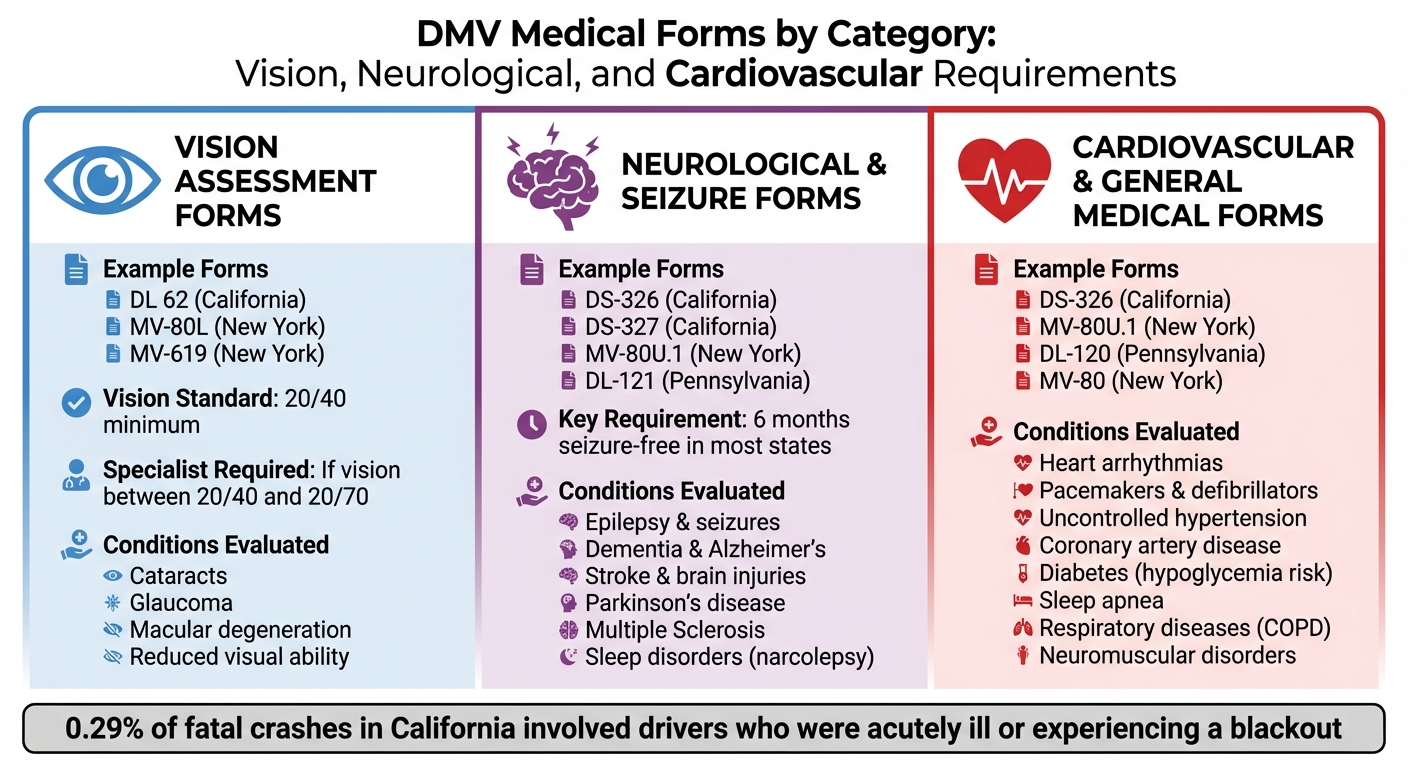
DMV Medical Forms by Category: Vision, Neurological, and Cardiovascular Requirements
The DMV uses forms across three main categories - vision, neurological/seizure, and cardiovascular/general - to evaluate conditions that could affect a person's ability to drive. Below are examples of these forms and the specific health issues they address.
Vision Assessment Forms
Vision-related forms ensure drivers meet the minimum standard of 20/40 vision or help establish necessary restrictions, like limiting driving to daylight hours [8]. Examples include California's DL 62 (Report of Vision Examination) and New York's MV-80L (Eye Test Report). In some states, if a driver’s vision falls between 20/40 and 20/70, an evaluation from an eye specialist may be required [4].
Seizure and Neurological Condition Forms
These forms focus on conditions that can impair consciousness or motor function. Examples include California's DS-326 (Medical Evaluation), New York's MV-80U.1 (Medical Report for Driver License), and Pennsylvania's DL-121 (Lapses of Consciousness Report) [1][3][11]. Conditions like epilepsy, seizures, strokes, Parkinson's disease, Alzheimer's, dementia, and sleep disorders such as narcolepsy are commonly addressed. Physicians provide details such as the date of the last seizure or blackout and the frequency of episodes, which help determine when it’s safe for a person to drive again. Many states require individuals to be seizure-free for at least six months before regaining driving privileges [3][5].
Heart Condition and Other Medical Forms
Cardiovascular forms are used to assess symptoms that might lead to sudden driving impairments, such as fainting, dizziness, or difficulty breathing. Forms like Pennsylvania's DL-120 (Cardiovascular Report) and New York's MV-80U.1 are typically completed for drivers with heart conditions like arrhythmias, pacemakers, defibrillators, uncontrolled hypertension, or coronary artery disease [2][4].
General medical forms cover a broader range of chronic conditions, including insulin-dependent diabetes (due to the risk of severe hypoglycemia), respiratory diseases like COPD, and neuromuscular disorders such as muscular dystrophy or severe arthritis [2][10][11]. A study in California revealed that 0.29% of drivers involved in fatal crashes were reported by police to be acutely ill or experiencing a blackout at the time of the accident, highlighting the importance of these evaluations for public safety [10].
| Form Category | Example Forms | Conditions Evaluated |
|---|---|---|
| Vision | DL 62 (CA), MV-80L (NY), MV-619 (NY) | Cataracts, glaucoma, macular degeneration, reduced visual ability [8][2][10] |
| Neurological | DS-326 (CA), DS-327 (CA), MV-80U.1 (NY), DL-121 (PA) | Epilepsy, seizures, dementia, Alzheimer's, stroke, brain injuries, Parkinson's, Multiple Sclerosis [9][2][11] |
| Cardiovascular | DS-326 (CA), MV-80U.1 (NY), DL-120 (PA) | Heart arrhythmias, pacemakers, defibrillators, uncontrolled hypertension, coronary artery disease [2][11] |
| Other Medical | DS-326 (CA), MV-80 (NY) | Diabetes (hypoglycemia), sleep apnea, narcolepsy, respiratory diseases, neuromuscular disorders [2][10][11] |
These forms provide a framework for identifying who is responsible for completing each section and how the submission process is organized. Providers can use a medical document fax service to ensure these forms are delivered securely and meet strict DMV deadlines.
Who Fills Out Which Sections of the Form
DMV medical and vision forms are split into two parts: one for the patient and another for the healthcare provider. Completing the correct sections properly helps avoid delays and ensures the form meets DMV requirements.
What Patients Need to Complete
Patients are responsible for filling out and signing the first three sections of the form before handing it over to their doctor. Take California's Driver Medical Evaluation (DS 326) as an example. Patients need to:
- Provide personal details, including their full name, driver's license number, date of birth, street address, and daytime phone number.
- Complete a health history questionnaire that covers over 18 medical categories, such as seizures, vision issues, heart disease, diabetes, and psychiatric conditions.
- Sign a medical information authorization, allowing the DMV to access their records.
For any "Yes" response in the health history, patients must also include the onset date, diagnosis, current medications, and the name and address of their treating physician. Additionally, they must sign a statement certifying under penalty of perjury that all the information provided is accurate.
"The Health History and Medical Information Authorization sections on page 1 must be completed and signed by the patient before you complete his Driver Medical Evaluation form." – California DMV [1]
Once these sections are completed, the form is ready for the healthcare provider to take over.
What Healthcare Providers Need to Complete
After the patient has done their part, the healthcare provider steps in to evaluate and certify the medical information. Qualified providers - such as physicians, physician assistants, or nurse practitioners - are tasked with completing the clinical evaluation sections, often labeled Sections 5 through 13 on forms like California's DS-326.
In this portion, providers must:
- Record vision scores and provide detailed diagnoses (e.g., epilepsy, arrhythmia).
- List medications along with their dosages.
- Document test results, such as visual acuity, HbA1C levels for diabetes, or serum levels for seizure management.
- Conduct functional assessments to evaluate cognitive or physical impairments, rating them as "Mild", "Moderate", or "Severe."
- Mark any non-applicable sections as "N/A."
The most critical part is the professional certification. Here, the provider states their clinical opinion on whether the patient is medically fit to drive safely. They must include their full name, office address, phone number, signature, license number, and the date of the patient visit. Missing any of these details may result in the form being rejected and requiring resubmission. [1][2][6]
Deadlines and How Long the Process Takes
Sticking to DMV deadlines is a must. Missing one can result in a suspended license, so it’s important to stay on top of the timeline from receiving a notice to submitting the required documents.
Deadlines After You Receive a DMV Notice
DMV notices include a "Return By" date, which is your deadline for submission. For example, in California, drivers generally have 26 days to complete and submit a Driver Medical Evaluation (DME) after it’s requested [16]. This time frame is meant to cover scheduling appointments, completing the form, and returning it to the DMV.
For vision-related issues, California allows a 30-day temporary license if your vision falls between 20/40 and 20/70. During this period, you must visit a specialist and submit a completed Report of Vision Examination (DL 62) [15]. In Illinois, drivers are required to notify the Secretary of State's office within 10 days if they develop a medical condition that could affect their driving ability [15].
| State/Entity | Submission Deadline | Key Condition |
|---|---|---|
| California | 26 days | Deadline to return completed DME form [16] |
| California | 30 days | Temporary license for vision issues [15] |
| Illinois | 10 days | Notify DMV of new medical condition [15] |
| Federal (FMCSA) | 45 days | Time between vision report and medical exam [13] |
"If you do not complete the DME, the DMV can suspend your driver's license." – Neil Shouse, Attorney, Shouse Law Group [16]
Failing to meet deadlines can lead to an immediate suspension of your driving privileges [16][18]. This suspension remains in place until you submit the required documents or request an administrative hearing. If you receive a suspension notice, you usually have 10 days to request a hearing, though your license will stay suspended during the process [17][9].
To avoid complications, act as soon as you receive a DMV notice. Schedule an appointment with your healthcare provider immediately, and complete your portion of the form (typically Sections 1–3) before the visit [16][1]. Choosing a specialist familiar with your condition - like a neurologist for seizures or an endocrinologist for diabetes - can save time since they already have your medical history [1].
Once you’ve met your deadlines, the next step is ensuring your provider completes their part of the process without delay.
How Long It Takes Providers to Complete Forms
Providers play a key role in meeting submission deadlines. Forms like California’s DS 326 require detailed evaluations, often spanning four out of five pages [17][1].
For simpler cases, such as vision assessments, a provider familiar with your history may complete the form during a single visit. However, forms for chronic or neurological conditions often require recent lab work, which can add several days to the process [1][3]. More complex situations might involve additional testing, further delaying completion.
Keep in mind that vision reports often have expiration dates, which vary by state. For instance, in New York, vision test results are valid for 12 months, while in California and Hawaii, they are typically valid for 6 months [14][15]. To avoid repeating evaluations, submit your completed forms as soon as possible.
sbb-itb-0df24da
How to Submit DMV Forms: Fax, Mail, or Online
When it's time to submit your completed DMV forms, the method you choose - fax, mail, or online - can make a big difference. The right option often depends on your state's requirements and how quickly you need the form processed.
Fax is often the quickest and most efficient way to submit forms. For example, California’s Driver Medical Evaluation form includes a specific "Fax Number" field so physicians can send completed forms directly to the DMV [1]. Similarly, in New Mexico, all original medical reports must be faxed daily to the Medical Unit [6]. Faxing ensures documents are delivered in hours, making it ideal for urgent submissions like suspension warnings.
Online portals are another fast option, though availability varies by state. In Pennsylvania, healthcare providers can use secure login credentials to submit forms like the DL-102 (Vision) or DL-121 (Seizure) directly into the system [3]. This eliminates manual processing and speeds up the review process. However, not all states offer online submission, so it’s worth checking your local DMV's options.
Mail, while reliable, is the slowest method. If you’re working with tight deadlines, mailing forms can introduce unnecessary delays. That said, it’s a solid choice for routine renewals or non-urgent submissions. Just make sure to send forms to the exact Medical Review address listed on your notice [12].
If your deadline is within 5 to 7 days, faxing is usually the safest bet to ensure enough processing time before any suspension takes effect [12]. And no matter which method you choose, always keep a copy of your completed form for your records [1].
The following sections dive deeper into when faxing is the best option and why using HIPAA-compliant solutions is so important.
When Faxing Is Recommended or Required
Faxing is often required or strongly encouraged in certain situations. For instance, in New Mexico, field offices must scan and fax medical reports to the central Medical Unit on the same day [6].
"All original Medical Reports must be faxed to the Medical Unit in Santa Fe... on a DAILY BASIS." – New Mexico Motor Vehicle Division [6]
If you’re dealing with a suspension warning or a tight deadline, faxing is the best way to ensure your documents are received on time. Unlike mail, which can take several days to arrive (and even longer for processing), faxing delivers your forms within minutes. This gives DMV staff more time to review your submission and update your record, reducing the risk of delays or penalties.
Faxing also provides proof of timely submission. Most fax services generate delivery confirmations, which can serve as evidence if any disputes arise. This reliability makes faxing a preferred choice for urgent or critical submissions.
Why HIPAA-Compliant Faxing Is Necessary
Speed is important, but so is protecting sensitive information. DMV medical forms often contain Protected Health Information (PHI), which means they fall under HIPAA regulations. For example, California Vehicle Code §1808.5 states that medical information submitted to the DMV is confidential and not available for public inspection [1]. This makes secure transmission methods a must.
Traditional fax machines and retail fax services can pose security risks. Paper copies left on trays or in public spaces can expose PHI to unauthorized access [7]. Retail fax services also lack the access controls and audit trails needed for HIPAA compliance.
HIPAA-compliant online fax services address these issues by using advanced encryption - SSL/TLS for data in transit and AES-256 for data at rest [7]. These services send documents directly to secure digital inboxes, eliminating the risks associated with physical paper. They also provide audit logs and real-time delivery confirmations, which are critical for compliance and record-keeping [7].
"Fax needs to be HIPAA compliant whenever it is transmitting PHI (Protected Health Information) and/or ePHI (electronic Protected Health Information)." – Fax.Plus [7]
For healthcare providers, using a HIPAA-compliant fax service is non-negotiable. These services often include a Business Associate Agreement (BAA), which is legally required when a third party handles PHI [7]. Failing to comply with HIPAA can result in severe penalties, including fines and even jail time of up to 10 years [7]. Services like OneFaxNow ensure secure transmission with instant BAA execution and audit-ready handling.
Here’s a quick comparison of traditional faxing versus HIPAA-compliant digital faxing:
| Feature | Traditional Fax | HIPAA-Compliant Digital Fax |
|---|---|---|
| Encryption | None | AES-256 (At Rest) / TLS (In Transit) |
| Audit Trail | Limited/Manual | Full Digital Logs |
| PHI Security | Low (Paper left on tray) | High (Encrypted digital inbox) |
| Hardware Required | Physical Machine & Line | None (Internet-connected device) |
| Legal Compliance | Risky for HIPAA | BAA-supported for HIPAA |
Understanding these submission methods will help you choose the safest and most efficient way to send your DMV forms. Next, we’ll explore how fax services compare and why solutions like OneFaxNow stand out.
Comparing Fax Services for DMV Medical Forms
When it comes to submitting DMV medical forms that involve Protected Health Information (PHI), picking the right fax service is essential. Factors like cost, compliance, reliability, and speed can vary widely between providers. Here's how they compare.
OneFaxNow vs eFax
eFax has been around for years and operates on a subscription model. In contrast, OneFaxNow offers a pay-per-fax option with no account required, making it perfect for one-time DMV submissions. On the other hand, eFax is better suited for those who send faxes regularly.
| Feature | OneFaxNow | eFax |
|---|---|---|
| Pricing Model | Pay-per-fax: 1–10 pages: $3.50; 11–50 pages: $5.00 | Monthly subscription (varies by plan) |
| HIPAA Compliance | Optional HIPAA mode: +$3.00 (Lite) or +$5.00 (Standard); instant BAA execution via dashboard | Available via eFax Protect and eFax Corporate plans |
| Account Needed | No | Yes |
| Delivery Tracking | Real-time status link + email updates; auto-retries up to 3x | Real-time delivery notifications via email or mobile app [22] |
| File Support | PDF, DOCX, TXT, JPG, JPEG, PNG, TIF, TIFF (up to 50 pages) | Multiple formats supported |
| Payment Capture | Success-only (charged only when fax is delivered) | Monthly billing regardless of usage |
Last verified: December 29, 2025
Why OneFaxNow for DMV forms: If you're submitting a one-time medical form to the DMV, OneFaxNow's pay-per-fax pricing is a cost-effective choice. You avoid paying for a monthly subscription, and the optional HIPAA mode ensures compliance. Plus, instant BAA execution saves time and effort. Check out OneFaxNow DMV Forms for more information.
OneFaxNow vs Fax.Plus

This comparison highlights the differences between subscription-based services and pay-per-fax options. Fax.Plus is known for its reliability, boasting 99.99% uptime [7]. However, HIPAA compliance is only available on their Enterprise plan, which requires a subscription and a signed Business Associate Agreement (BAA). This can be a hurdle for occasional users.
| Feature | OneFaxNow | Fax.Plus |
|---|---|---|
| Pricing Model | Pay-per-fax: 1–10 pages: $3.50; 11–50 pages: $5.00 | $6.99/month (billed annually) for 200 pages; additional pages $0.10 each [20] |
| HIPAA Compliance | Optional HIPAA mode: +$3.00 (Lite) or +$5.00 (Standard); instant BAA | Enterprise plan only; BAA required [7] |
| Account Needed | No | Yes |
| Delivery Speed | Real-time tracking with auto-retries | Inbound faxes in less than 20 seconds [7] |
| Audit Trail | Full audit logs with HIPAA mode | Detailed logs on Enterprise plan [7] |
| File Attachments | Supported | Disabled when HIPAA mode is enabled [7] |
Last verified: December 29, 2025
"Fax.Plus is the HIPAA-compliant online fax service built for healthcare providers handling patient data." – Fax.Plus [7]
Why OneFaxNow for DMV forms: Fax.Plus requires a subscription and an Enterprise plan for HIPAA compliance, making it less practical for one-time users. OneFaxNow, on the other hand, allows you to send a single HIPAA-compliant fax without any long-term commitment. Instant BAA execution ensures a smooth and quick process. Learn more at OneFaxNow HIPAA Fax.
OneFaxNow vs Free and Retail Fax Options
Free services like FaxZero and retail locations such as FedEx or UPS might seem appealing, but they have significant downsides - especially when handling PHI. Retail faxing can cost $1.80–$2.49 per page [19], and free services often lack the security features needed for HIPAA compliance.
| Feature | OneFaxNow | FaxZero (Free) | Retail (FedEx/UPS) |
|---|---|---|---|
| Pricing | 1–10 pages: $3.50; 11–50 pages: $5.00 | Free for up to 5 faxes/day (3 pages each); $2.09 for up to 25 pages [20] | $1.89–$2.49 per page [19] |
| HIPAA Compliance | Optional HIPAA mode with BAA | Not publicly stated | No (privacy risks with paper left on public machines) [7] |
| Convenience | Online/mobile (24/7) | Online (24/7) | Requires travel to physical location |
| Hidden Costs | None | Ads on cover page (free version) | Travel ($2–$20), parking ($1–$5) [19] |
| Delivery Tracking | Real-time status link + email | Email confirmation | Physical receipt upon request [21] |
| Encryption | AES-256 (at rest), TLS (in transit) | Not publicly stated | None (physical paper) [7] |
Last verified: December 29, 2025
Why OneFaxNow for DMV forms: OneFaxNow stands out by offering HIPAA compliance, unlike free or retail options. Retail faxing is not only costly but also inconvenient - a 10-page DMV form could cost $18–$25 at FedEx, plus travel expenses. Free services such as FaxZero lack the necessary security and BAA agreements, making them unsuitable for medical forms. OneFaxNow provides HIPAA-compliant faxing starting at $6.50 (Lite with HIPAA mode), all from the comfort of your home. For more details, visit OneFaxNow Medical Forms.
These comparisons show why a HIPAA-compliant, pay-per-fax service like OneFaxNow is the smart choice for DMV medical forms.
Final Thoughts on Submitting DMV Medical Forms
Key Points to Remember
When dealing with DMV medical forms, precision and timeliness are everything. Start by ensuring that patients complete their sections first - this includes health history, personal details, and the medical information authorization. Only after this step can the healthcare provider finalize the rest of the form [23][1]. Be thorough when filling out the fields - if something doesn’t apply, write "N/A" to avoid unnecessary delays or rejection [1].
Deadlines are critical. States like Louisiana require forms to be returned within 30 days of the notice date [23][24]. Additionally, vision test results often expire after 12 months, so check that your evaluation is up to date [14]. For commercial drivers under FMCSA rules, the physical qualification exam must begin within 45 days of the vision specialist’s signature [13].
"Medical information is CONFIDENTIAL under California Vehicle Code §1808.5 CVC" – California Department of Motor Vehicles [1]
Protect sensitive health data: DMV medical forms often contain private details such as psychiatric diagnoses, substance use history, and treatment records [23]. Healthcare providers must use HIPAA-compliant methods to securely fax or transmit these forms [25]. This ensures both accuracy and privacy, meeting legal and ethical requirements.
Why OneFaxNow Works for DMV Forms
If you’re looking for a secure, hassle-free way to submit DMV medical forms, OneFaxNow has you covered. Here’s why it stands out:
OneFaxNow offers a simple, HIPAA-compliant solution for one-time DMV form submissions without the need for subscriptions. You can securely fax your form from home in about 60 seconds for just $6.50 (Lite) or $10.00 (Standard) with the HIPAA mode. For healthcare providers, the optional HIPAA add-on includes features like instant BAA execution, audit logs, and encrypted transmission - ensuring full compliance with legal standards [25].
Compared to retail faxing, which can cost Compared to retail faxing, which can cost $18–$25 for 10 pages8–$25 for 10 pages plus travel time, OneFaxNow is a more affordable and convenient option. Free faxing services often lack the necessary security measures, making them unsuitable for sensitive documents. With OneFaxNow, you get real-time tracking, automatic retries, and a guarantee that you’ll only be charged when your fax is successfully delivered. Plus, you’ll receive a status email with a tracking link, so you’re always in the loop.
For a secure, reliable, and cost-effective way to handle DMV submissions, OneFaxNow is the ideal choice. Learn more at OneFaxNow DMV Forms or explore their HIPAA-compliant services at OneFaxNow HIPAA Fax.
Send a Fax Online - No Account Required
FAQs
What are the consequences of missing the DMV medical or vision form deadline?
If you miss the deadline to submit your DMV medical or vision form, you might face penalties like late fees, which can range from $5 to $10 in some states. Worse, your driver’s license or driving privileges could be suspended. This suspension usually stays in place until the DMV receives and processes the required forms.
To steer clear of these problems, make sure to complete and submit the forms as soon as you get the notice. If your healthcare provider is responsible for sending the forms, double-check that they’ve submitted them on time through the correct method - whether it’s fax, mail, or an online upload.
How can I securely send my medical information to the DMV?
When sending medical information to the DMV, it's crucial to use a HIPAA-compliant fax service. These services secure sensitive data by encrypting it and transmitting it over protected lines - offering far more security than public or retail fax machines. This extra layer of protection helps keep your personal details private and aligns with strict privacy laws.
The DMV mandates that all personal information be transmitted securely, following state privacy regulations. A secure fax service minimizes risks and ensures your data is delivered to the DMV safely and without unnecessary complications.
What medical conditions require DMV medical or vision forms?
When the DMV learns that a driver has a condition that might impact their ability to drive safely, they often require medical or vision forms to be completed. These forms help assess whether the individual can continue driving without posing a risk to themselves or others. Some common conditions that might prompt this requirement include:
- Vision problems that can’t be corrected with glasses or contacts
- Seizure disorders or other conditions leading to sudden loss of consciousness
- Heart-related issues such as heart attacks, strokes, or other cardiovascular diseases
- Diabetes or similar metabolic conditions
- Neurological disorders, including epilepsy or cognitive challenges
- Respiratory conditions like asthma or emphysema
- Musculoskeletal limitations that affect movement or strength, such as limb loss or spinal injuries
- Kidney disease, frequent dizziness, or fainting episodes
- Use of medications that might impair motor skills or judgment
Drivers are typically required to disclose such conditions through state-specific DMV forms, such as California's DS-326 or Virginia's MED-2. If someone is diagnosed with one of these conditions or begins experiencing symptoms that could interfere with safe driving, the DMV generally asks for a healthcare provider to complete the necessary documentation for further evaluation.