When Government Offices Still Prefer Fax Over Email (and Why It’s Not Going Away Yet)
Why government agencies still use fax: legacy systems, legal record rules, secure delivery, and audit-ready online fax options with HIPAA support.
When Government Offices Still Prefer Fax Over Email (and Why It’s Not Going Away Yet)
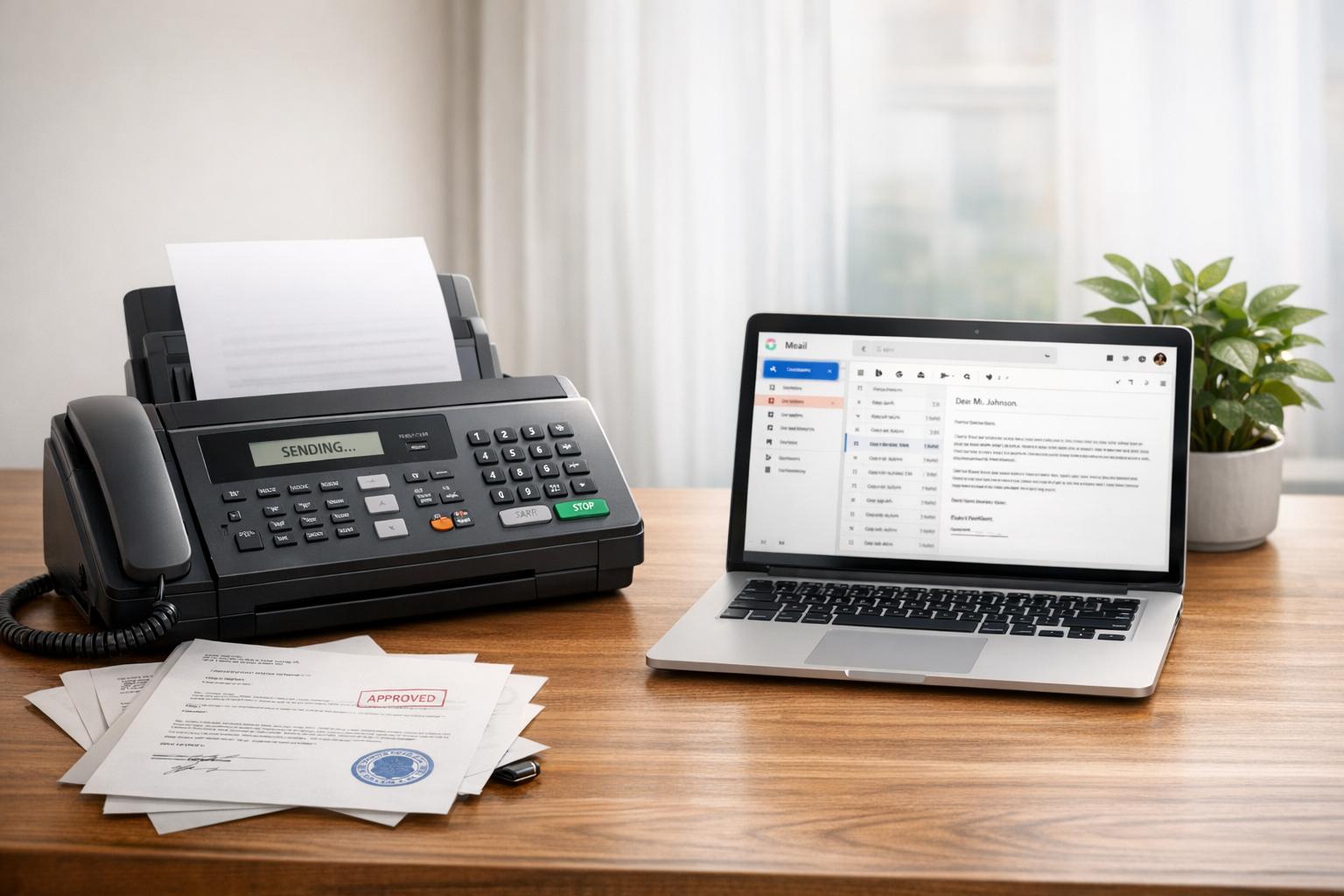
Government offices still rely on fax machines, even in a digital age. Why? Faxing offers reliability, legal compliance, and secure transmission that email often lacks. From outdated systems to strict privacy laws, fax persists as a practical solution for handling sensitive documents. Here's why it's not disappearing anytime soon:
- Legacy Systems: Many government workflows are built around decades-old infrastructure, making fax integration easier than email.
- Legal Compliance: Fax provides timestamped delivery records and meets federal record-keeping standards.
- Privacy and Security: Fax transmissions are direct and less vulnerable to interception compared to email.
- Key Use Cases: FOIA requests, police reports, DMV forms, and licensing applications heavily rely on fax for secure and verifiable submissions.
Modern online fax services, like OneFaxNow, streamline the process by eliminating the need for physical machines while maintaining compatibility with government workflows. These services are tailored for occasional users, offering pay-per-fax vs. subscription pricing, real-time tracking, and optional HIPAA-compliant modes for sensitive data.
Fax remains a cornerstone of government communication due to its reliability, legal standing, and ability to meet strict compliance requirements.
Why Government Offices Still Use Fax
Legacy Systems and Existing Workflows
Back in the 1980s, government agencies built their infrastructure around fax machines, tailoring systems to handle paper-based workflows. Many of these systems still run on COBOL-based back-office software, which was designed to manage paper records - not modern digital communication like email or cloud sharing [3].
Updating these outdated systems comes with a hefty price tag. In fact, 80% of IT budgets are dedicated to maintaining legacy systems, and the federal government faces a $100 billion challenge to modernize its technology [7] [8]. Take the Federal Aviation Administration, for example: as of July 2025, 105 out of its 138 air traffic control systems were considered unsustainable, with some hardware unsupported because the original manufacturers no longer exist [8].
Even when systems are digitized, they often don’t work well together. This disconnect creates a frustrating "print-fax-scan" loop, where documents need to be manually reformatted to move between systems [2]. The Obama administration allocated over $30 billion through the HITECH Act to encourage a shift to electronic records, but the effort fell short in requiring interoperability between systems [2]. As Farzad Mostashari, former National Coordinator for Health IT, famously said:
"If we want to kill the fax, we need to schedule a funeral." [2]
These outdated workflows persist not just because of technical inertia but because they align with strict legal standards.
Legal and Compliance Requirements
Fax machines stick around not just because they’re old but because they meet essential legal, compliance, and security needs. Fax is legally recognized as a valid form of record-keeping. Under 44 U.S.C. 3301, the National Archives and Records Administration (NARA) officially declared facsimile transmissions as Federal records in 1996 [1]. John W. Carlin, a former Archivist of the United States, clarified this point:
"Facsimile transmissions have the same potential to be Federal records as any other documentary materials received in Federal offices." [1]
For legal matters where timing is critical, fax provides something email often can’t: an immediate transmission record that serves as proof of delivery [6]. This is crucial for tasks like Freedom of Information Act (FOIA) requests, court filings, and regulatory submissions.
Fax also plays a key role in privacy and security compliance, particularly under the Privacy Act (5 U.S.C. 552a) [9]. Unlike standard email, which can be intercepted or blocked by spam filters, fax transmits documents directly between endpoints, ensuring secure delivery. This level of reliability is why about 75% of all medical communication in the U.S. - including government-regulated healthcare, DMV medical reviews, and licensing boards - still relies on fax [2].
Between outdated infrastructure and stringent compliance demands, fax remains a cornerstone of government operations, valued for its reliability and legal standing.
Government Departments That Still Rely on Fax
FOIA Requests and Records Units
Many FOIA offices at federal, state, and local levels still rely heavily on fax machines. This is especially true for smaller local agencies like city councils, county offices, and school districts, which often lack the budget to implement modern online submission systems [6].
Faxing provides a same-day transmission record that serves as legal proof of submission - an essential feature when meeting deadlines. Most FOIA pages list specific fax numbers and often require a "FOIA Request" cover page to ensure documents are routed correctly [6].
In a notable example from February 2017, the FBI stopped accepting FOIA requests via email, instead directing users to submit requests through their online portal (which limited users to one request per day), fax, or standard mail. This decision demonstrated how even well-funded federal agencies sometimes lean on older technologies to handle the legal and logistical demands of public records requests [4].
Beyond public records, faxing also plays a critical role in law enforcement operations.
Police and Incident Reports
Law enforcement agencies depend on fax to securely transmit sensitive incident records to insurers, attorneys, and HR departments [5]. These records often include personally identifiable information (PII) and details about ongoing investigations. Fax offers a secure and verifiable method of delivery, which fits seamlessly into existing records management systems.
DMV and Medical Review Departments
Faxing is equally vital for DMV offices, especially when handling documents containing sensitive personal information. Across the country, DMV offices use fax to process SR-22 insurance forms and medical or vision reports for driver fitness evaluations [5]. These documents often involve private health data, requiring secure handling to comply with federal privacy regulations. Modern services address these concerns by providing digital fax security through encryption and audit logs.
Even when DMV systems are partially digitized, software incompatibilities frequently lead to a "print-fax-scan" cycle, where digital records must be printed, faxed, and then scanned back into another system [2].
Licensing Boards
Professional licensing agencies, such as medical boards and contractor licensing offices, also heavily rely on fax for processing applications and compliance paperwork [5][6]. Fax provides the necessary audit trail and legal proof to meet strict regulatory timelines. Many licensing boards even maintain separate fax lines specifically for application submissions, ensuring documents are directed to the correct department without delay [6].
The Problems with Email for Government Communication
Spam Filters and File Size Limits
Government email systems are often equipped with strict security measures, including spam filters that quarantine messages from unknown senders and impose tight limits on attachment sizes. These filters can block messages without providing clear delivery confirmation, leaving senders unsure if their communication reached its destination. Unlike fax, which generates a transmission record as proof of delivery, email offers no such guarantee once the message leaves your outbox[6].
Attachment size restrictions add another layer of difficulty. Government email systems frequently limit file sizes, making it challenging to send large documents like FOIA responses, medical records, or detailed incident reports. In contrast, one-time online fax services such as OneFaxNow can handle files up to 20 MB and 50 pages per transmission. This capability makes fax an ideal solution for managing the high-volume documents that government offices regularly process. These limitations highlight email's shortcomings in providing reliable delivery proof - a gap that fax services effectively address.
Missing Audit Trails
While email might seem convenient, its lack of a verifiable audit trail makes it unsuitable for legal and compliance purposes. For sensitive records, fax offers a clear advantage with its timestamped delivery records. Fax services generate detailed status reports that include transmission completion times, sender information, and page counts. By comparison, email delivery receipts - when available - only confirm that the message left the sender’s outbox, offering little assurance of actual receipt[6].
This lack of accountability poses challenges for government agencies, which are required to maintain Federal records under 44 U.S.C. 3301. Fax transmissions provide a dependable paper trail, while email threads can become fragmented or lost, especially when messages are forwarded or bounce between systems. The U.S. government has invested over $30 billion through the HITECH Act to digitize medical records, yet around 75% of all medical communication still occurs via fax due to the unreliability of digital systems in sharing data[2].
"Medical records generally come by fax. Sometimes they're mailed. They almost never come by any other route." - Amanda Rohn, OB-GYN, Arlington Women's Center[2]
The FBI’s 2017 decision to stop accepting FOIA requests via email - redirecting citizens to fax, mail, or a restrictive web portal - further underscores email's limitations for managing official records[4].
Why Government Agencies Trust Fax
Reliable Delivery and Legal Acceptance
Fax continues to hold a strong position in government operations because of its unmatched reliability and legal standing. It provides a timestamped transmission record, detailing the time sent, page count, and receipt confirmation - features that comply with federal record-keeping requirements[1].
A notable example of fax's importance came in March 2017, when the FBI stopped accepting Freedom of Information Act (FOIA) requests via email. Instead, citizens were directed to use fax or physical mail. This decision stemmed from the agency's need for secure procedural controls and dependable transmission records, something email could not guarantee[4]. Services like OneFaxNow add to this reliability by retrying failed deliveries automatically at 3, 6, and 12-minute intervals, and they don’t charge if all attempts fail. Most faxes are successfully delivered within 1–3 minutes[6][10].
Lower Risk of Document Tampering
Fax also stands out for its ability to guard against document tampering. When documents are sent via fax, they are transmitted as static images - formats like PDF, TIF, or JPG - which significantly reduces the risk of unauthorized changes. Additional safeguards, such as encrypted transmissions and strict deletion policies, further enhance security, making fax a more tamper-resistant option for sensitive communications[6].
For government tasks involving Protected Health Information (PHI) - like DMV medical reviews or licensing board applications - fax services such as OneFaxNow offer additional protections. These include HIPAA Mode, which provides audit logs and instant Business Associate Agreements (BAA)[6][5]. By combining static image formats, encryption, and controlled retention policies, fax ensures a secure and reliable method for handling official government records.
sbb-itb-0df24da
How Online Fax Services Work for Government
Online Fax Without Hardware
Modern online fax services remove the need for bulky machines, dedicated phone lines, and endless paper supplies, while still working seamlessly with government offices that rely on traditional fax systems. These platforms translate digital files into fax signals that legacy fax machines can process. The process is straightforward: upload your document through a browser, input the fax number, and hit send. The receiving office uses their existing fax machine as usual, without even realizing the fax originated from a digital service. This streamlined approach supports government operations while introducing a more efficient way to handle communications.
OneFaxNow Features for Government Use
OneFaxNow takes this hardware-free approach a step further, offering features tailored to government workflows. With a pay-per-fax model, users only pay for what they send - no accounts or subscriptions needed. Pricing is simple: $3.50 for 1–10 pages (Lite) and $5.00 for 11–50 pages (Standard). Importantly, charges only apply when the fax is successfully delivered. If all retry attempts fail, there’s no cost.
Government offices often handle sensitive information, such as Protected Health Information (PHI) in DMV medical reviews or licensing board applications. To address these needs, OneFaxNow offers an optional HIPAA mode. This includes end-to-end encryption, detailed audit logs, and instant Business Associate Agreements (BAAs) that can be downloaded directly from the dashboard. The BAA is ready to execute immediately, making compliance easier for time-sensitive submissions.
Given government agencies' reliance on fax for legal and compliance purposes, OneFaxNow ensures reliability through secure and audit-friendly processes. If a fax line is busy, the platform automatically retries at 3, 6, and 12-minute intervals, with most faxes successfully delivered within 1–3 minutes. Users can track the status of their faxes in real time through email updates and a status page. To enhance security, documents are transmitted over encrypted channels and automatically deleted after delivery, reducing the risk of data breaches.
Online Fax Service Comparison
Fax vs Email vs Online Fax Services for Government Communication Comparison
Feature and Pricing Comparison
Government employees and citizens filing occasional forms - like FOIA requests, DMV paperwork, or police reports - often face a choice between subscription-based fax services and pay-per-fax options. For those who only need to send a fax once in a while, this decision can make a big difference.
Subscription services such as eFax, Fax.Plus, and iFax charge monthly fees starting at $15, whether you send one fax or dozens. These services require users to create an account, manage login credentials, and commit to recurring billing. For someone submitting a one-time FOIA request or a medical form to the DMV, this can feel like overkill.
OneFaxNow offers an alternative: no account, no subscription, and payment only if the fax is successfully delivered. If the fax fails after all retries, you’re charged nothing. This makes it an ideal choice for occasional government filings where proof of transmission is essential, but ongoing costs are not.
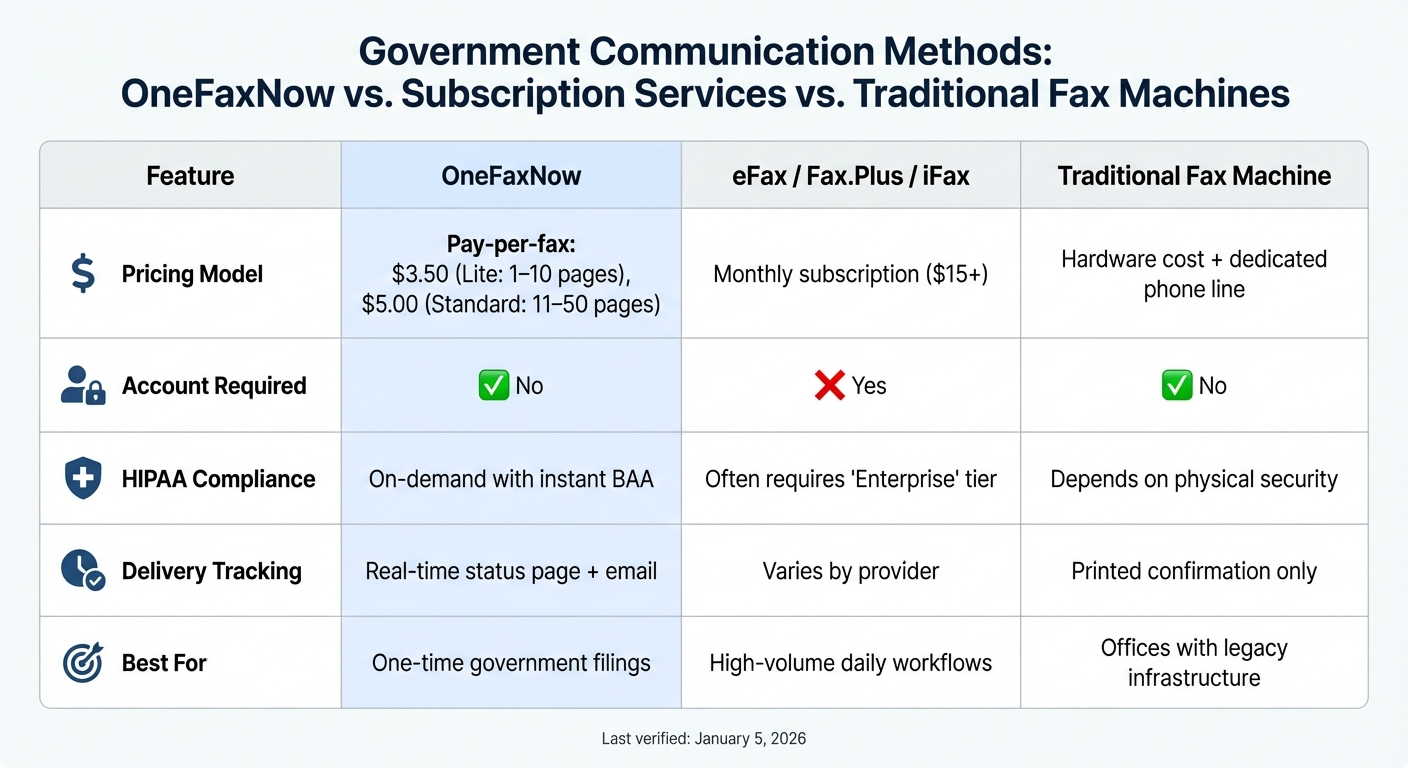
| Feature | OneFaxNow | eFax / Fax.Plus / iFax | Traditional Fax Machine |
|---|---|---|---|
| Pricing Model | Pay-per-fax: $3.50 (Lite: 1–10 pages), $5.00 (Standard: 11–50 pages) | Monthly subscription ($15+) | Hardware cost + dedicated phone line |
| Account Required | No | Yes | No |
| HIPAA Compliance | On-demand with instant BAA | Often requires "Enterprise" tier | Depends on physical security |
| Delivery Tracking | Real-time status page + email | Varies by provider | Printed confirmation only |
| Best For | One-time government filings | High-volume daily workflows | Offices with legacy infrastructure |
Last verified: January 5, 2026
For workflows involving Protected Health Information (PHI), OneFaxNow offers an optional HIPAA-compliant mode for an additional fee (+$3.00 for Lite, +$5.00 for Standard). This includes end-to-end encryption, audit logs, and an instant Business Associate Agreement (BAA) that you can download immediately. In contrast, subscription services often hide HIPAA features behind expensive, higher-tier plans.
This comparison shows why OneFaxNow is a practical choice for government-related tasks. Let’s explore how it directly addresses the unique needs of government workflows.
Why OneFaxNow Works for Government Workflows
Government offices often rely on outdated systems, and OneFaxNow provides a modern solution that works seamlessly with existing fax infrastructure - without the hassle of physical machines or recurring subscriptions. The pay-on-success model fits perfectly with how most people interact with government agencies: occasionally, not daily.
For tasks like FOIA requests, police reports, or DMV forms, OneFaxNow’s features - such as no account requirement, automatic retries, and real-time delivery tracking - solve common communication challenges. It processes faxes in under 60 seconds, charges only for successful deliveries, and provides a clear audit trail for verification.
This approach benefits both citizens and small offices, who only pay when they send a fax, avoiding unnecessary subscription fees. For government-related use cases, it’s a straightforward and cost-effective solution.
Conclusion
Fax continues to play a critical role in government operations, addressing the limitations of email when it comes to delivery reliability and maintaining a solid audit trail. Legacy systems, spam filters, and strict compliance standards ensure fax machines remain staples in FOIA offices, police departments, DMV medical review units, and licensing boards across the country. These workflows often mirror those used for insurance claims and medical records, where security is paramount. These setups highlight fax's dependability for legal submissions, offering verifiable transmission records that email simply can't provide. This is where modern online fax solutions step in to bridge the gap.
Online fax services are especially useful for citizens and small offices that only need to send government forms occasionally. They eliminate the need for bulky fax machines, dedicated phone lines, or recurring fees. Take OneFaxNow, for example. With this service, you pay only when your fax is successfully delivered - $3.50 for 1–10 pages or $5.00 for 11–50 pages. It also includes real-time tracking, automatic retries, and email confirmation, making the process seamless and stress-free.
When it comes to government filings, verifiable proof of delivery is non-negotiable. OneFaxNow delivers on this front with real-time tracking and status updates, meeting the same legal requirements that government agencies rely on. For handling sensitive information, like PHI, the service offers a HIPAA-compliant mode with encryption, audit logs, and an instant Business Associate Agreement (BAA) you can download immediately.
Until full digitization becomes a reality, fax remains the most practical method for submitting urgent records. Online fax services bring speed, affordability, and simplicity to the table. With a pay-per-success model, you only pay for transmissions that go through, all while maintaining the audit trail and legal compliance that government workflows demand.
Send a Fax Online - No Account Required or explore more about HIPAA-compliant faxing requirements.
FAQs
Why do government offices still rely on fax machines instead of email?
Government offices continue to rely on fax machines because they are deeply woven into existing workflows and legal requirements. Many agencies operate with legacy systems and paper-based processes, where fax numbers remain the official channel for submitting essential documents like records requests, police reports, DMV forms, and other regulated paperwork. For decades, faxing has been an established communication method, retaining its legal validity in many situations.
Another reason faxing remains popular is its reliability and traceability. Unlike email, which can encounter issues such as spam filters, file size restrictions, or missing delivery confirmations, fax transmissions provide automatic delivery receipts and maintain a tamper-proof log. These features align with strict record-keeping and evidentiary standards, making fax a dependable choice for government agencies that prioritize document integrity and accountability.
Why are modern online fax services beneficial for government workflows?
Modern online fax services have revolutionized government workflows by replacing clunky, outdated fax machines with a sleek, digital alternative. With these services, users can upload documents - like PDFs or images - straight from their browser, pay only for successful transmissions, and track delivery in real-time. This creates a reliable and audit-ready process that traditional email or mail often falls short of providing.
For government agencies, the benefits are clear. Online faxing slashes the costs and headaches of maintaining physical fax machines and managing paper-based processes. These platforms also come with advanced security features, including optional HIPAA compliance and encrypted storage, making them perfect for securely transmitting sensitive records like medical files or law enforcement reports. By blending the trusted functionality of fax with modern technology, these services deliver a fast, secure, and cost-efficient solution that bridges the gap between legacy system demands and today’s operational needs.
Why do government offices still rely on fax instead of email for communication?
Fax remains a widely used communication tool in many government offices due to its distinct legal and practical benefits. In the United States, fax transmissions are classified as official Federal records, requiring the same level of preservation as physical documents. This classification ensures that faxes maintain an audit trail and hold evidentiary value, making them dependable for legal and regulatory processes.
Moreover, certain laws and agency policies specifically mandate fax for particular filings, such as FOIA requests, police reports, or submissions to the DMV. These procedures often depend on older systems that work seamlessly with fax but not with email. Fax also offers a reliable delivery record, complete with time-stamped proof of receipt, which helps agencies meet compliance standards while avoiding problems like lost or filtered emails. For these reasons, fax remains a practical and legally reliable method of communication in government operations.