Why Fax Is Still Required in 2026 for Some Healthcare, Legal, and Government Workflows
Fax persists in 2026 because recipient rules, legacy systems, and audit needs still require it; modern online fax bridges the gap.
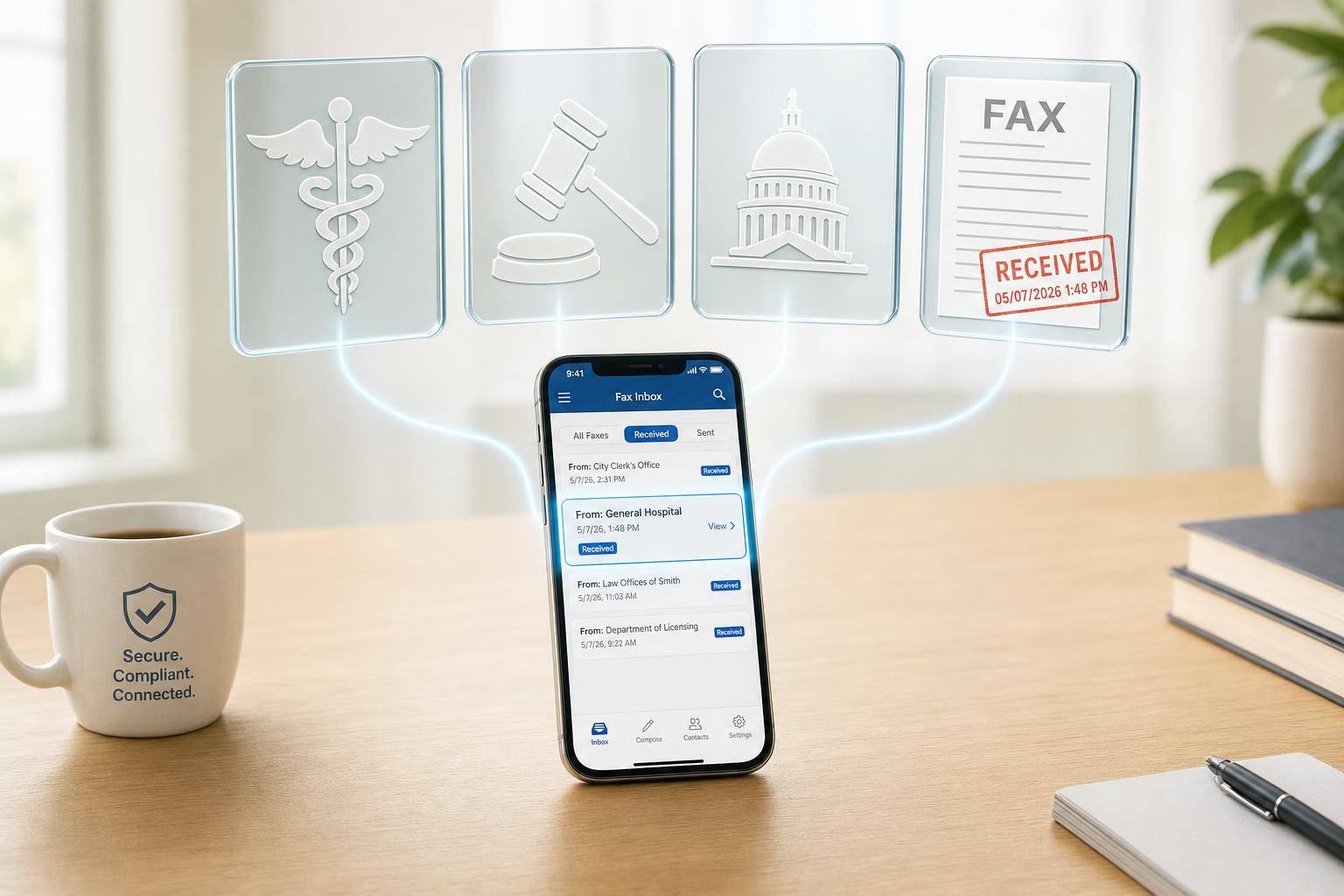
Why Fax Is Still Required in 2026 for Some Healthcare, Legal, and Government Workflows
Yes, fax is still part of some U.S. workflows in 2026. I’d sum it up like this: if a hospital, court, insurer, or agency says “send it by fax,” you still need a way to fax it.
Here’s the short version:
- HIPAA does not ban fax
- Some recipients still require or allow fax
- Old systems still don’t connect well
- Teams still want time-stamped delivery records
- Online fax is usually easier than paper faxing
That’s why fax still shows up in:
- Healthcare: prior authorizations, records requests, referrals, insurance forms
- Legal work: court and agency documents when local rules allow fax
- Government: FOIA requests, appeals, and official forms
I also think the article’s main point is simple: the issue is not whether fax is old. The issue is whether the other side still accepts anything else.
A few facts stand out:
- Healthcare data often moves through different standards, such as X12 for admin work and HL7 for clinical data
- Some online fax pricing in the article is $3.50 for 1–10 pages and $5.00 for 11–50 pages
- File support can include PDF, DOCX, JPG, PNG, TIF, and TIFF
- Some services offer status emails, tracking links, retries, and a BAA for PHI
If I were reducing the whole piece to one takeaway, it would be this: fax stays in place when rules, old platforms, and record-keeping needs have not caught up to fully digital intake.
Quick comparison
| Option | Best for | Main issue | What the article points to |
|---|---|---|---|
| Paper fax machine | Offices that fax a lot | Hardware, phone line, paper | More setup and more hassle |
| In-store fax | One-off sends | Travel, public machine, per-page cost | Weak privacy and added time |
| Monthly online fax | People who fax often | Recurring fee | Can make sense for steady use |
| Pay-per-fax online | Occasional sends | Per-send fee | Often the best fit for one-off regulated sends |
So before sending anything, I’d check the recipient’s current rules, page limits, fax number, and deadline. That’s what decides whether fax is still part of the job.
Why Regulated Organizations Still Use Fax
Fax is still around for a simple reason: rules, systems, and audit needs haven’t lined up yet. That mismatch helps explain why fax keeps showing up in healthcare, legal, and government work.
Regulatory Inertia and Published Submission Rules
Many published submission rules still list fax as an accepted or required channel. And rule changes tend to happen piece by piece. One workflow may shift to digital, while the workflow right next to it still depends on fax. That kind of partial change is a big reason fax remains required in some places, even as other teams move away from it.
Legacy Systems and Interoperability Gaps
Even when an organization wants to go digital, its systems often don’t connect cleanly. Government agencies handling FOIA requests still work through fragmented legacy workflows (often requiring users to fax a FOIA request to ensure delivery) that depend on manual handoffs between intake, review, redaction, and reporting[2]. So a document that could move electronically may still be faxed because the workflow isn’t fully connected.
Healthcare runs into the same issue. Payers, providers, and labs may all use different portals and EHRs, and the standards don’t always line up across each workflow. Administrative transactions use X12, while clinical data uses HL7[1]. When direct digital exchange isn’t available, fax becomes the fallback. You see the same kind of gap in public records and legal workflows too.
Internal Controls, Audit Trails, and Delivery Records
Another reason fax sticks around is that it creates a standard transmission record, including timestamps and page counts, that fits existing compliance and records-management processes. Many digital tools also log delivery. But not every recipient treats those logs as enough proof, which keeps fax in the mix.
| Root Cause | Effect on Workflow | Why It Persists in 2026 |
|---|---|---|
| Regulatory Inertia | Some published submission rules still list fax as an accepted or required channel | Rule changes happen bit by bit, and healthcare modernization is still rolling out in stages |
| Legacy Systems | Fragmented platforms create manual handoffs | Government and healthcare workflows still run across disconnected systems |
| Interoperability Gaps | Different organizations use standards that do not always align | X12 and HL7 do not always align across every workflow |
| Internal Controls | Fax provides a standardized transmission record | Organizations still rely on timestamps and routing records while electronic replacements are not universal |
These limits show up most clearly in healthcare, legal, and government workflows.
sbb-itb-0df24da
Where Fax Is Still Used: Healthcare, Legal, and Government
These limits show up most often when the recipient controls how something must be sent. That’s why fax still shows up in a few stubborn places, especially healthcare paperwork, court filings, and FOIA requests.
Healthcare: Records Requests, Referrals, and Insurance Paperwork
Healthcare is one of the clearest examples. In many payer workflows, prior authorization still goes through fax because that’s the channel the receiving side requires.
The same pattern applies to faxing medical records requests, referral packets, and insurance forms. It’s not that fax is the best option. It’s that fax remains the accepted route on the other end, so providers and staff keep using it.
Legal: Court and Administrative Documents Where Local Rules Permit Fax
Legal work follows the same logic. Fax stays in use when a court or agency still lists it as an accepted submission method.
For courts and administrative offices, check the official instructions before you send anything. Look at the current fax number, page limit, cover sheet rules, and filing deadline. Small details matter here, and using old instructions can cause problems fast.
Government: FOIA, Appeals, and Official Forms
Government agencies often use fax for the same reason: some current submission rules still allow it in certain workflows.
FOIA requests are a clear example. Some agencies still list fax as an accepted intake channel, and the same can apply to appeals and official forms. Before sending anything, check the latest directions on the official form or the agency’s website.
The Better Answer Is Modern Fax, Not No Fax
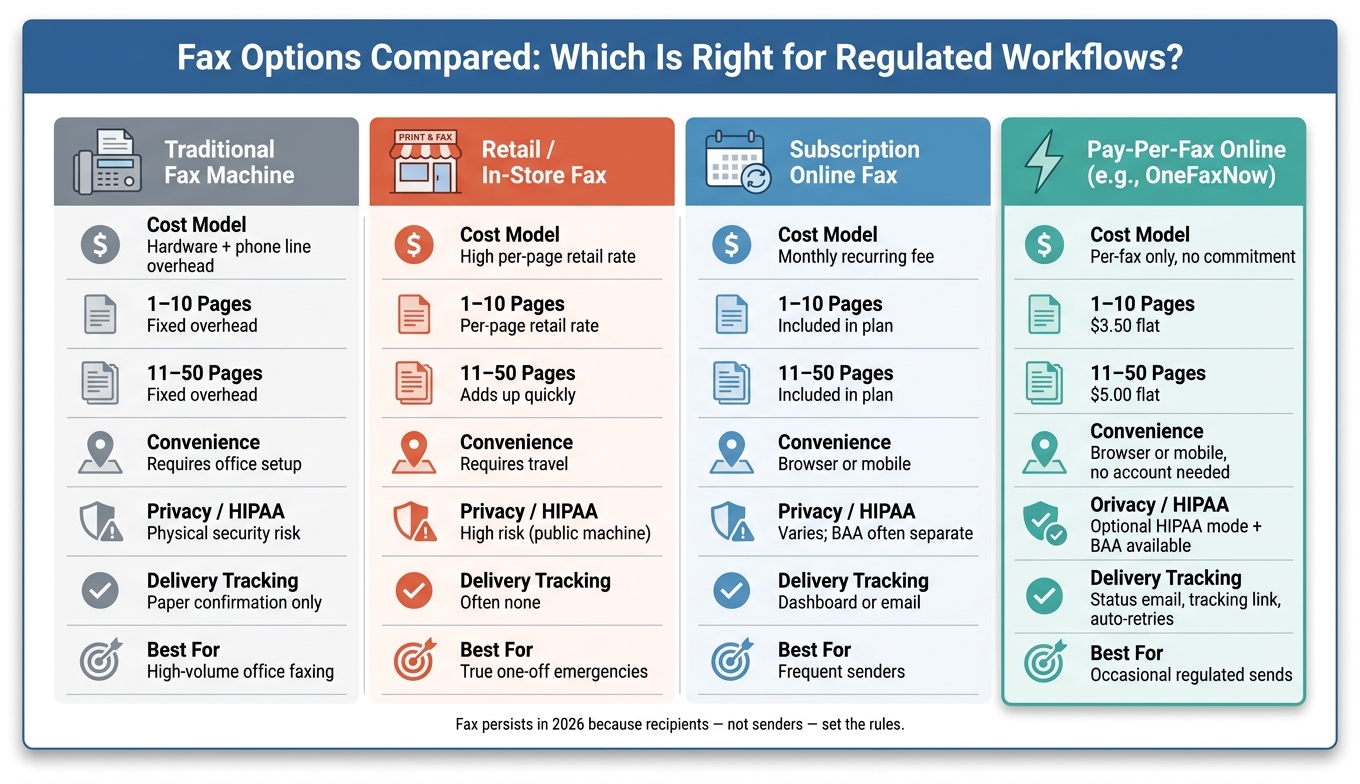
Fax Options Compared: Traditional vs. Online for Regulated Workflows (2026)
In healthcare, legal, and government work, one thing keeps coming up: the recipient decides how documents must be sent. So if a hospital, court, or agency wants a fax, the sender needs a fax-ready workflow.
That doesn't mean you need to fax without a fax machine sitting in your office.
The better move is to keep fax compatibility while changing how you send. In plain English: don't get rid of fax. Use a modern way to handle it.
What Online Fax Fixes for Senders
Old-school faxing comes with a lot of baggage. You need hardware, a phone line, and paper. If you use a retail fax counter, you also need to leave home or the office, wait in line, and hand over documents at a shared machine. That's not great for privacy.
Online fax cuts out those hassles. You can upload a file, send it online, and get:
- delivery status
- automatic retries
- a delivery record
That paper trail matters. If a payer, court, or agency later challenges whether something was sent on time, you have something to point to.
How to Choose Between In-Store Faxing, Subscriptions, and Pay-Per-Fax
The differences are easier to spot when the options sit next to each other.
| Feature | Traditional fax machine | Retail fax service | Subscription online fax | Pay-per-fax (OneFaxNow) |
|---|---|---|---|---|
| Cost | Hardware + phone line | High per-page retail rate | Monthly recurring fee | Per-fax only, no commitment |
| 1–10 pages | Fixed overhead | Per-page retail rate | Included in subscription | $3.50 flat |
| 11–50 pages | Fixed overhead | Adds up quickly | Included in subscription | $5.00 flat |
| Convenience | Requires office setup | Requires travel | Browser/mobile access | Browser/mobile, no account needed |
| File support | Paper only | Paper only | PDF, DOCX, and more | PDF, DOCX, JPG, PNG, TIF, TIFF, and more |
| Delivery tracking | Paper confirmation | Often none | Dashboard or email | Status email, tracking link, automatic retries |
| HIPAA handling | Physical security risk | High risk (public machine) | Varies; BAA often required separately | Optional HIPAA mode + BAA available |
| Account required | N/A | None | Yes | Not required for standard sends |
If you only send a fax once in a while, a subscription can feel like paying rent on something you barely use. A one-time FOIA request or a single medical records transfer usually doesn't justify a monthly plan.
Retail faxing can be even worse. The per-page costs stack up fast, and once you add travel time, the bargain disappears. On top of that, privacy is often weakest at a public fax counter.
For occasional regulated sends, pay-per-fax online fax is usually the better fit.
Why OneFaxNow Fits Occasional Regulated Faxing
OneFaxNow is built for occasional regulated faxing. For standard sends, there's no account required. Pricing is simple: $3.50 for 1–10 pages and $5.00 for 11–50 pages. Payments run through Stripe, with capture only on successful delivery.
For healthcare documents, there's an optional HIPAA mode, plus a Business Associate Agreement (BAA). Each send includes a job ID, a tracking link, status emails, and automatic retries. Supported file types include PDF, DOCX, TXT, JPG, PNG, TIF, and TIFF, with support for up to 50 pages.
If you want workflow-specific details, see the OneFaxNow use-cases hub, HIPAA Fax page, and FOIA fax guide.
That puts modern fax in a useful middle spot for regulated workflows.
Conclusion: Fax Persists Because Recipient Rules and Systems Still Require It
In 2026, fax is still around for a simple reason: the recipient often sets the rules. In some workflows, legacy systems, intake policies, and internal controls still make fax the required option. Hospitals, FOIA teams, and insurers still rely on it when electronic intake isn't accepted or just isn't practical.
That’s why the answer isn’t no fax. It’s modern fax.
CMS is phasing out fax for some healthcare attachments, but prior authorization still sits outside that mandate. That leaves a gap, and modern online fax fills it.
You may not control the format the recipient demands. But you can control how you send it, with less hassle and no paper-based mess.
So the practical move is to modernize fax, not stick with paper faxing. Need to send a medical records request, FOIA submission, or insurance claims or forms today? Send a Fax Online - No Account Required with OneFaxNow. For PHI, use the HIPAA fax option.
FAQs
Why can’t I just email it?
In 2026, fax still shows up in parts of healthcare, legal, and government work. The reason isn’t nostalgia. It comes down to regulatory inertia, old systems that are still in place, and the need for secure, verifiable document delivery.
Some rules are starting to move past fax, but many day-to-day processes still lean on it. Prior authorizations and FOIA requests are two clear examples. So the change happening now isn’t about wiping out fax overnight. It’s about updating how fax works by using secure digital tools and clear audit trails.
Is fax still legally valid in 2026?
Yes. Under the CMS-0053-F final rule, CMS is phasing out fax and mail for some claims documentation starting May 26, 2026. The goal is simple: cut admin work, tighten security, and speed up processing.
That said, this does not mean fax disappears across the board.
Some workflows still run on legacy systems or paper-heavy processes. So while modernization is pushing fax into more automated setups, it hasn’t fully fixed the root problem underneath.
When do I need HIPAA fax?
You need HIPAA fax when a healthcare workflow still depends on fax. Fax use is shrinking for some claims attachments under standards that take effect on May 26, 2026, but that shift does not remove fax from healthcare.
Fax-based workflows still exist where legacy systems, internal controls, and tech gaps continue to shape healthcare and related records processes.