Prior Authorization Fax Denials: 7 Common Mistakes and How to Avoid Them
Most prior authorization fax denials come from simple errors—missing IDs, wrong payer faxes, incomplete clinicals, incorrect codes, timing, or clerical mistakes.
Prior Authorization Fax Denials: 7 Common Mistakes and How to Avoid Them
Prior authorization fax denials are often caused by simple, avoidable errors. These mistakes can delay patient care and create unnecessary administrative work. Here’s what you need to know:
- Most common errors: Missing patient details (e.g., Member ID, DOB), wrong fax numbers, incomplete clinical documentation, incorrect codes, late submissions, and clerical mistakes.
- Impact: These errors can delay treatment by up to 15 days and lead to serious patient care issues, as reported by 67% of physicians.
- Solutions: Use a prior authorization fax cover sheet checklist, verify payer fax numbers, organize documents, and track faxes in real time to ensure accuracy and compliance.
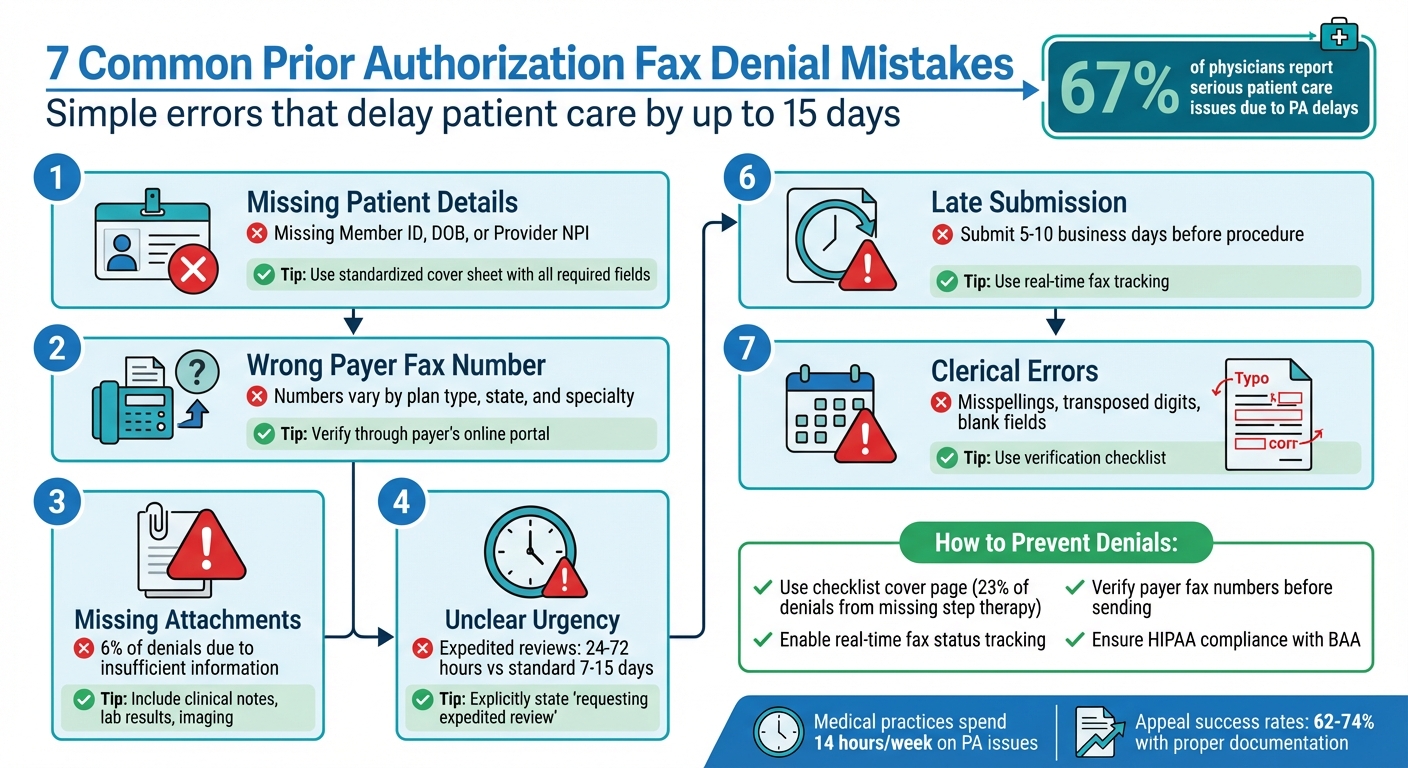
7 Common Prior Authorization Fax Denial Mistakes and Prevention Tips
7 Common Mistakes That Cause Prior Authorization Fax Denials
When it comes to prior authorization denials, content errors are often the root cause - not issues with the fax machine itself. These mistakes can delay patient care, but they’re avoidable. Let’s break down seven common errors and how to steer clear of them.
Missing Member ID, Date of Birth, or Provider NPI
Every prior authorization request relies on key identifiers: the Member ID, date of birth, and the provider’s National Provider Identifier (NPI). These details help payers match the request to the correct patient and verify the provider’s credentials. If any of these are missing, the system will reject the fax outright.
To avoid this, double-check the Member ID against the patient’s insurance card - insurance plans can change frequently. Use a standardized HIPAA cover sheet that includes fields for the patient’s name, DOB, Member ID, and Provider NPI to ensure nothing is overlooked. These small steps can save you from unnecessary delays.
Wrong Payer Fax Number
Sending your request to the wrong fax number wastes time and could mean missing critical deadlines. Fax numbers often vary depending on the plan type (e.g., Commercial, Medicare Advantage), state, or even the specialty of the service. For instance, UnitedHealthcare processes prior authorization faxes for commercial plans in specific states (like Massachusetts or Texas) at 855-352-1206 [3]. Meanwhile, OptumRx uses different lines for specialty and non-specialty medications [4].
Always verify the fax number through the payer's online provider portal or the specific prior authorization form. Make sure the number matches both the patient’s plan and the service type. This step is just as important as ensuring the accuracy of patient data.
Missing Attachments: Clinical Notes, Lab Results, or Imaging
If you forget to include clinical notes, lab results, or imaging, your request will likely be denied. In fact, 6% of denials are due to "Insufficient Information Provided" [2]. Payers need this documentation to determine the medical necessity of the request.
Organize your documents so the authorization form comes first, followed by supporting materials like clinical notes and test results. This way, reviewers can easily connect the evidence to the requested service, avoiding unnecessary delays.
Missing or Unclear Urgency and Deadline Information
For cases requiring expedited review (processed within 24–72 hours instead of the standard 7–15 days), it’s crucial to clearly state this on the cover page. Simply writing "urgent" or "ASAP" isn’t enough. Instead, explicitly note: "I am requesting expedited appeal review" [2].
If the delay could harm the patient’s health, document this clearly. Failing to provide this information can add weeks to the process, even for critical cases.
Incorrect or Outdated CPT and ICD Codes
Nearly 48% of denials are labeled as "Not Medically Necessary", often because the submitted codes don’t align with the payer’s criteria [2]. Using the wrong CPT or ICD codes can signal non-coverage or mismatched diagnoses.
Before you fax the request, review the payer’s "medical policy bulletins" to ensure the codes you’re using meet their criteria. Ensure your documentation addresses all the requirements outlined in their policy.
Late Submission Timing
Timing is everything. Sending a prior authorization request too close to the procedure date - or after it - can result in an automatic denial. Many plans require submissions 5–10 business days before the scheduled service.
Track the payer’s submission deadlines and build in extra time for potential resubmissions or follow-ups. Using real-time fax tracking can help you confirm the exact time your request was sent.
Clerical Errors: Misspellings and Blank Fields
Simple mistakes like misspelled names, transposed Member ID digits, or blank fields on the form can lead to immediate rejections. These issues are categorized as administrative errors and are entirely avoidable, but they still cost valuable time.
To prevent these errors, use a checklist to verify that all required fields are complete and legible before sending. Double-check the quality of scanned documents - illegible faxes are treated the same as incomplete ones.
sbb-itb-0df24da
How to Prevent Prior Authorization Fax Denials
Fax denials can disrupt patient care and add unnecessary administrative burdens. On average, medical practices spend 14 hours per week managing prior authorization issues, much of which involves fixing avoidable errors [2]. By following these three strategies, your staff can submit complete and accurate requests right from the start.
Use a Checklist Cover Page
A well-organized cover page acts as a final quality check before sending. Include a checklist that clearly outlines key details such as:
- Member ID and Date of Birth
- Provider NPI
- Required attachments (clinical notes, lab results, imaging)
- CPT/ICD-10 codes
- Step therapy information, if applicable
Since 23% of denials arise from missing step therapy documentation [2], add a "Conservative Treatments Attempted" prompt to your checklist. For time-sensitive cases, emphasize urgency by writing "EXPEDITED PRIOR AUTHORIZATION" prominently at the top [2].
"Prior authorization denials are not final. With proper documentation and appeal strategy, you can overturn the majority of these denials." - AJ Friesl, Founder, Muni Health [2]
Before sending, always confirm that the fax numbers are up-to-date to avoid delays.
Verify Payer Fax Numbers Before Sending
Using outdated fax numbers can derail the entire process. Always pull the fax number directly from the payer’s official resources. Keep in mind that fax numbers often vary based on plan type, state, and specialty. Double-checking ensures the number aligns with the patient’s specific plan and the service being requested. Since prior authorization remains a largely manual process, submissions can occasionally get lost [5]. After verifying the number, track your submission to confirm it reaches the intended destination using a secure insurance document fax service.
Use Real-Time Fax Status Tracking
Real-time tracking eliminates uncertainty by providing instant delivery confirmation and audit logs. Services with automated retries (up to three attempts) ensure delivery without requiring manual follow-ups [1]. Digital logs with immutable timestamps confirm when the fax was delivered, which is especially helpful for resolving disputes about receipt. To avoid unnecessary costs, select a service that charges only for successful deliveries - this "zero-risk billing" approach protects your budget [1].
"Prior authorization packets almost always contain PHI... If the packet includes diagnoses, lab results, or treatment notes, treat it as PHI and use HIPAA Mode." - OneFaxNow [1]
Enable HIPAA mode and ensure your Business Associate Agreement (BAA) is in place to safeguard Protected Health Information (PHI). Save transmission logs (in PDF or CSV format) to the patient’s EHR to maintain a complete record for audits or appeals [1].
Comparison of Online Fax Services for Prior Authorization
When it comes to prior authorizations (PA), choosing the right online fax service is critical. These faxes often include Protected Health Information (PHI) like diagnosis codes, lab results, and member IDs, making compliance, cost, and reliability key factors. Below is a comparison of leading fax platforms and their features.
Fax Service Comparison Table
| Service | Pricing Model | 1–10 Pages | 11–50 Pages | HIPAA Compliant? | BAA Available? | Account Required? | Delivery Tracking | Auto Retries | Success-Only Billing |
|---|---|---|---|---|---|---|---|---|---|
| OneFaxNow | Pay-per-fax | $6.50 (HIPAA) | $10.00 (HIPAA) | Yes (Optional Mode) | Yes (Instant) | No | Real-time + Audit Dashboard | Up to 3 | Yes |
| SRFax | Subscription | ~$11.45/mo (200 pages) | Included | Yes | Yes | Yes | Email confirmation | Yes | No |
| Fax.Plus | Subscription | $8.99/mo (200 pages) | Included | Only on $99.99/mo Enterprise | Yes (Enterprise only) | Yes | Email confirmation | Varies | No |
| eFax | Subscription | $16.95/mo (150 pages) | Overage fees apply | Yes (Business plans) | Yes | Yes | Email confirmation | Yes | No |
| RingCentral | Subscription | $7.99/mo (750 pages) | Included | Yes | Yes | Yes | Dashboard | Yes | No |
| FaxZero | Free/Pay-per-fax | Free (5/day, with ads) | $1.99 + per-page | No | No | No | Email only | No | No |
Last verified: April 9, 2026
For high-volume practices, subscription-based services are often the most cost-effective, while smaller clinics may prefer pay-per-fax pricing. HIPAA compliance can significantly impact costs - Fax.Plus, for instance, requires a $99.99/month Enterprise plan to access a Business Associate Agreement (BAA), while OneFaxNow includes instant BAA execution for as little as $6.50 per fax [6][1].
Why OneFaxNow Works for Prior Authorization
OneFaxNow is specifically designed to handle time-sensitive and compliant prior authorization faxes. One standout feature is its success-only billing - if all three automatic retries fail, you’re not charged [1]. The HIPAA Audit Dashboard is another game-changer, offering exportable logs (in CSV or PDF format) to document exactly when a fax was sent. This is invaluable for disputes with payers or appeals.
The platform also simplifies compliance. The Business Associate Agreement (BAA) is executed instantly at checkout and available for immediate download, eliminating delays caused by legal onboarding. Security is a priority, with files encrypted during transmission and storage, then automatically deleted after completion, leaving a permanent audit log [1]. Plus, no account is required, which means fewer security risks and faster processing - urgent PAs can be sent in under 60 seconds.
Real-time tracking adds another layer of reliability, showing every step of the fax process from connection to delivery. With its transparent pricing and user-friendly features, OneFaxNow helps prevent delays and reduces the risk of prior authorization denials.
<a href="https://onefaxnow.com/use-cases/prior-authorization-fax" rel="nofollow">Send a Prior Authorization Fax</a> - No Account Required | <a href="https://onefaxnow.com/hipaa-fax" rel="nofollow">Learn About HIPAA Fax</a>
Wrapping Up
Dealing with prior authorization fax denials can be a headache, but the good news is that most of these issues are avoidable. Errors like missing member IDs, incorrect payer fax numbers, incomplete attachments, or simple clerical mistakes are common culprits - and they’re also the easiest to catch and fix with a little extra care during the submission process.
Medical practices often lose valuable time on prior authorizations - time that could be better spent focusing on patient care [2]. Simple steps like using a checklist cover page, double-checking payer fax numbers, and leveraging real-time delivery tracking can remove much of the uncertainty. Plus, having proof of submission on hand can make all the difference if disputes come up.
"Prior authorization denials are not final. With proper documentation and appeal strategy, you can overturn the majority of these denials."
– AJ Friesl, Founder of Muni Health [2]
Strong documentation is key, with appeal success rates ranging from 62% to 74% [2]. But you can only appeal if you have proof of submission. Digital fax tools that offer HIPAA-compliant audit logs and real-time status tracking provide the necessary documentation to challenge denials effectively and help prevent delays in patient treatment.
FAQs
What should I include in a prior authorization fax packet?
When sending a prior authorization fax packet, it's essential to include all the required documentation to justify the medical necessity. Typically, this means adding:
- A signed, HIPAA-compliant Release of Information (ROI) form
- Relevant clinical records, such as progress notes, lab results, or imaging
- Patient details, including their full name, date of birth, and member ID
Make sure the packet also contains the provider’s NPI and contact details. To keep things clear and professional, organize everything with a concise cover sheet. Finally, always use a HIPAA-compliant faxing method to ensure the secure transmission of sensitive information.
How do I prove a prior auth fax was delivered on time?
To ensure a prior authorization fax was delivered on time, opt for a service that offers real-time status updates and tracking. Look for features like tracking links, timestamps, and delivery confirmations to provide clear documentation. Services with automatic retries and a focus on capturing only successful transmissions add an extra layer of reliability, making it easier for staff to confirm the fax was sent and received within the required timeframe. This can be crucial for demonstrating compliance when necessary.
When should I request an expedited prior authorization?
When dealing with urgent or time-sensitive medical situations, it's essential to request an expedited prior authorization. This process speeds up approval, ensuring patients get the care they need without unnecessary delays.